11
11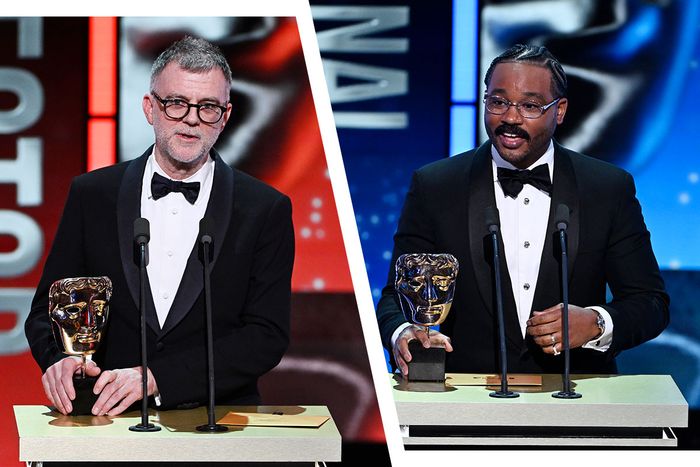

Paul Thomas Anderson and Ryan Coogler both won major prizes at last weekend’s BAFTAs.
Photo-Illustration: Vulture; Photos: Stuart Wilson/BAFTA/Getty Images
Lost in the hubbub over the BAFTAs’ racial-slur scandal — more on that below — is the fact that, awards-wise, Sinners did what it needed to do to stay in the Best Picture race Sunday night. A few weeks ago, I wrote about a possible Sinners surge, noting that Ryan Coogler’s film didn’t necessarily have to beat One Battle After Another for the top prize at BAFTA, it just needed to pick up high-profile wins in categories like Original Screenplay and Supporting Actress. That’s exactly what happened, though Team Sinners may rue not winning Casting, which went to the British film I Swear (ever heard of it?), or any other craft trophies beyond Score (the others were mostly divvied up between OBAA and Frankenstein). Still, Sinners won just enough to stay within striking distance of OBAA before this weekend’s moment of truth. Coming in the thick of final Oscar voting, the one-two punch of Saturday’s Producers Guild of America Awards and Sunday’s Actor Awards, née SAG Awards, will send a strong signal about where we’re heading in the season’s final stretch.
Thanks to some surprising results in the BAFTAs’ acting races, most major categories remain in flux ahead of the weekend’s double whammy. (The exceptions are Best Director and Best Actress, which appear earmarked for OBAA’s Paul Thomas Anderson and Hamnet’s Jessie Buckley, respectively.) After spending all season using my primitive monkey brain, I wanted to get a more objective view of where things stand, so I called up NumLock’s Walter Hickey, who takes a statistician’s approach to awards season. “The window is closing pretty quick,” he says. Anybody who wants to make up ground will have to do so this weekend.
With apologies to Hamnet, losing at BAFTA likely puts the kibosh on the Tudor tearjerker’s Best Picture hopes. So we’re down to a two-horse race between OBAA, which has been considered an Oscar juggernaut since September, and Sinners, which set the Oscars’ all-time nomination record last month. With two top prizes up for grabs this weekend — SAG’s Best Cast and the PGA’s Outstanding Theatrical Motion Picture — here’s how each permutation of results would shape the race.
OBAA wins both: This is the chalk pick, and it would cement PTA’s film as the most dominant Oscar frontrunner we’d seen in years. (Remember, even Oppenheimer lost some high-profile critics’ awards.) In this case, Ryan Coogler had better leave it all on the floor in his Original Screenplay acceptance speech.
Sinners wins both: According to Hickey’s model, if Coogler’s film did score a brace on the weekend, that would give us a race that “would be very close, but with Sinners narrowly ahead.” Personally, I would find it hard to overlook such a significant momentum shift at the business end of the season, so my more subjective analysis would probably discount everything that happened pre-nominations and assume Best Picture was now in the bag for Sinners.
Sinners wins PGA, OBAA wins SAG: If Sinners wins only one of this weekend’s awards, Hickey says, it would remain a significant underdog. Still, of the pair, PGA is the one you’d prefer to have. For five years running, the producers’ pick has gone on to win Best Picture. (Sorry to 1917, the last PGA winner not to repeat the feat with Oscar.) As Hickey notes, this is partly due to how the PGA votes: with a preferential ballot, the same as the Oscars. It’s partly due to who’s voting: the same types of white-collar institutional employees who make up the largest chunk of the Academy. And it’s partly due to why they’re voting: While other precursors have their own specialized tastes and interests, predicting the eventual Best Picture winner is the PGA’s primary goal. That’s also why a film rarely wins the PGA and nothing else. Still, there are 279 million reasons why a commercially minded precursor like the PGAs might spring for Sinners. Besides being the least likely result, I think this would also be the most confusing. Sinners would remain an outsider mathematically while feeling like the Hollywood insiders’ pick.
OBAA wins PGA, Sinners wins SAG: The Best Cast prize has less historical overlap with Best Picture. In the past decade, it’s gone to films like Hidden Figures, Black Panther, and The Trial of the Chicago 7. However, because we’ve previously seen two different Oscar dark horses take gold after winning SAG — Moonlight and Parasite — it would be easy to slot Sinners into our mental model of an unlikely Best Picture winner. Thus, even though Hickey’s calculations say winning only SAG would be worse for Sinners’s chances than winning only PGA, this outcome might feel better to its fans, since the film would now be tracing a path that Oscar watchers are already familiar with.
In the night’s biggest surprise, the BAFTAs gave their award to I Swear’s Robert Aramayo, the sole nominee not up for the Oscar. (Technically, Aramayo could have a Best Actor shot at next year’s ceremony, but that may prove … complicated.) You could see the result as the Brits rewarding homegrown talent, or as the BAFTAs as an institution trying to give I Swear a big push ahead of its U.S. release in April. You can also see it as a vote of no confidence in Timothée Chalamet as a front-runner, as well as in rivals Leonardo DiCaprio, Michael B. Jordan, and Ethan Hawke. In that case, it’s tempting to conclude this result was great news for The Secret Agent’s Wagner Moura, the sole Oscar nominee not up for the BAFTA. However, Moura isn’t up for SAG’s Actor Award, either, so he’ll be moving in silence like lasagna up until the Oscars.
The odds still favor Chalamet at SAG, where the youngster won last year for A Complete Unknown. Whatever happens there, Hickey is priming himself for a surprising result at the Oscars. “If the race is telling you there’s not unanimity among the voters, you want to listen,” he says. “When there’s not unanimity in the lead acting races, it can get really weird. With the supporting awards, people are looking for a sign of who’s going to be the winner. In lead, people are looking for chances their guy might have a shot.”
One of Hickey’s bugaboos is the way the supporting races have often been gift-wrapped early, with co-leads like Emilia Pérez’s Zoe Saldaña and A Real Pain’s Kieran Culkin sweeping to victory. Fortunately, that’s not been the case in Supporting Actress this year, as three different women have won the three major precursors so far. Amy Madigan won at Critics Choice, Teyana Taylor won the Golden Globe, and Wunmi Mosaku won at BAFTA. It’s anyone’s guess which of them has the edge with the guild. Madigan has the “give the veteran her due” narrative that paid off for Demi Moore at SAG last year. Taylor bats leadoff for the presumptive Best Picture favorite. Mosaku may well be Sinners’s best shot at an acting trophy. “Whoever gets tipped at SAG is going to have a good chance” at the Oscar, Hickey says. “People tend to look for answers there, and try to go with the herd.”
Supporting Actor is in the same spot as Supporting Actress: three precursors, three different winners. The situation is a bit more complicated, though, for two reasons. The first is that Golden Globe winner Stellan Skarsgård missed at SAG, so his race at the precursors is run. The second is that, by giving Sean Penn its trophy, BAFTA dispelled a major piece of conventional wisdom, which held that Penn and co-star Benicio del Toro would continue to split votes at the bigger awards bodies. (Pundits assume this is how Jacob Elordi won at Critics Choice.) Penn’s barely been campaigning and skipped the BAFTA ceremony entirely. Does his RFK-esque transformation pack enough of a punch to carry him to victory at SAG anyway? If so, that’d be a gas.
Only a month ago, an Oscar voter noted to me that this had been a controversy-free season. Now we’ve finally got some mess. And just like on Industry, the primary offender turns out to be the British Establishment, as embodied by BAFTA and the BBC, for what those across the pond might call the absolute cock-up they made of an incident from Sunday night’s ceremony.
To recap: John Davidson, a Tourette’s awareness activist who was the subject of the nominated biopic I Swear, shouted a racial slur while Sinners stars Michael B. Jordan and Delroy Lindo were presenting the award for Best Visual Effects. This was not the only involuntary remark of the evening — Davidson also shouted “pedophile” while Alan Cumming was onstage — nor was it the only one directed at someone from Sinners. Production designer Hannah Beachler wrote on X that she was also the recipient of similar language. Davidson later left the room of his own accord and says he privately apologized to Jordan, Lindo, and Beachler.
Tics associated with Tourette’s can be exacerbated by a stressful environment. Davidson told CNN on the BAFTAs red carpet that the heightened atmosphere of an awards show, with “lots of people around,” could potentially be triggering for him. As Rebecca Sun asked, “What measures did BAFTA take to ensure that he felt not only included, but also safe?” That’s not the only question that remains open after the ceremony. With five days of hindsight, here are all the snafus that, together, combined to create this week’s omnishambles:
BAFTA did not immediately apologize to Beachler, Jordan, and Lindo.
On the night, BAFTA’s main concern seems to have been protecting Davidson from blowback. After Davidson’s exit, Cumming came onstage to address the situation. “Tourette’s syndrome is a disability, and the tics you heard tonight are involuntary, which means the person who has Tourette’s syndrome has no control over their language,” Cumming said. “We apologize if you are offended tonight.” Afterward, Lindo told Vanity Fair he wished someone from BAFTA would have checked in with him and Jordan, sentiments echoed by Beachler. “I understand and deeply know why this is an impossible situation,” she wrote on X. “What made the situation worse was the throw away apology of ‘if you were offended.’” (After days of public outcry, BAFTA issued a more emphatic apology.)
The BBC did not act fast enough on the edit.
Initially, the BBC claimed that its broadcast team had not been aware of Davidson’s outburst as they were not physically in the room. This account was disputed by sources within Warner Bros., who told multiple publications that the studio had immediately raised an alarm with BAFTA and requested that the slur be removed from the BBC telecast. According to the studio, BAFTA assured them their concerns had been passed on to the BBC and the production company Penny Lane TV. This week, BAFTA confirmed that it had in fact done so.
The BAFTAs air on a two-hour delay, more than enough time to remove the offending outburst from the broadcast. The fact that they didn’t has generated conspiracy theories about whether the BBC intentionally let Davidson’s remark make it to air with the intent of creating a viral moment. However, this theory was complicated by the news that the broadcaster did successfully edit out a second racial slur from the BAFTAs. The most likely inference, then, is that this weeklong controversy was the result of someone messing up within the BBC and letting the first slur slip through. If only there were an influential sitcom about the culture of incompetence and ass-covering in British institutions!
But the BBC did manage to edit out “Free Palestine.”
Compounding the fallout from Sunday night’s ceremony is that the BBC did prevent another moment from making the BAFTA telecast. While accepting the trophy for Best British Debut, My Father’s Shadow director Akinola Davies Jr. dedicated the award “for Nigeria, for London, Congo, Sudan, free Palestine,” remarks that were cut when the ceremony aired. The broadcaster has claimed the cuts were purely for length, as the three-hour ceremony needed to fit into a two-hour telecast, and that other acceptance speeches were similarly trimmed. Given the way pro-Palestinian activism has been treated in the U.K., you can decide whether to believe it or not.
No one thought the BAFTA seating through.
In a postmortem with Variety, Davidson noted that, while his seat was far enough away from the BAFTA stage that he assumed he wouldn’t be audible, it was also located near a microphone. “With hindsight I have to question whether this was wise,” he said, quite Britishly. This tidbit has spurred more theorizing about producers hoping Davidson’s tics would go viral, though audiences are routinely mic’d up at awards shows, and BAFTA later clarified that the microphone was monitoring EQ levels rather than amplifying sound. The blame game between the organization and the BBC is likely to persist for days to come.
See All