Priced at Thousands of Dollars per Kilogram, Baby Eels Have Set Off a Global Frenzy | The Walrus

AROUND 9 P.M. ON April 10, 2024, James Nevin parked his truck next to the Shubenacadie Canal in Dartmouth, Nova Scotia, scanning the banks for a good spot to fish. There were others already there, so he decided against it; the year before, he had been threatened by other fishers holding guns.
For years, Nevin had earned his living, in part, fishing elvers—baby eels—in the rivers, streams, and canals of Nova Scotia. That spring, Fisheries and Oceans Canada (DFO) had announced it would not open elver fishing season, citing illegal fishing as a threat to stock health and commenting that the fishery “has also become the focus of harassment, threats and violence,” with incidents creating “an immediate threat to the fishery management and public safety.” For most people, to be fishing now would mean breaking the law.
Nevin was about to reverse his truck out of the parking lot when an unmarked vehicle cut him off, beaming its headlights into the dark. Two men got out of the car and shined a light in his face. He recalls them hitting the hood of his truck. Nevin thought he was being robbed. He tried to escape by backing up. (In a statement to The Walrus, DFO says Nevin “tried to evade officers while behind the wheel and struck a Nova Scotia Conservation Officer with a vehicle.”)
Nevin then jumped out of the truck to see who the figures were. One of the men pepper-sprayed him. Nevin says his hands were bound with plastic ties; the pepper spray made it hard for him to breathe. The pair then identified themselves as enforcement working on behalf of DFO. Halifax police were called, and they took him to a regional police station. Nevin was later charged with two counts of assault and obstructing enforcement—charges he denies. He claims he was restrained with violence by the conservation officers for no reason; because Nevin is Mi’kmaw, he has constitutionally protected treaty rights to fish for a moderate livelihood—regardless of when the DFO closes the season.
In 1999, First Nation treaty rights to fish, hunt, and harvest to earn a “moderate livelihood” were enshrined through the verdict in a Supreme Court case now known as the Marshall decision. In 1993, Mi’kmaw fisherman Donald Marshall Jr. was charged with fishing and selling eels without a licence during the fishery’s off season and using illegal nets. He argued that he had a treaty right to fish as a traditional and life-sustaining practice. When the Supreme Court agreed, the decision affirmed the rights of First Nations to harvest for a moderate livelihood year round. Despite revised legal rulings after Marshall, what constitutes “moderate livelihood” has been ambiguous. For the elver industry, there are millions of dollars at stake.
Elvers’ journey into Atlantic Canadian waters starts in the Sargasso Sea, in the middle of the Atlantic, where they spawn amidst the dense masses of free-floating seaweed. The baby eels are carried by strong currents to the northeast coast of North America, where they mature in brackish estuaries. The elvers, or “glass eels” due to their transparent bodies, are caught at less than ten centimetres long, well before they eventually grow longer and turn darker.
It is their juvenile form that has turned an odd-looking, slippery fish into an expensive commodity. Elvers are now Canada’s most valuable fish. Driven by demand in Asia, glass eels can fetch thousands of dollars per kilogram (approximately a one-litre bottle full)—even sometimes more than $5,000 per kilogram. In 2022, fishers in Nova Scotia and New Brunswick earned $39 million from 7,557 kilograms of elvers harvested, according to DFO.
In 2024, after DFO declined to open the elver season—which typically runs from March through June in Atlantic Canada—it informed nine commercial elver licence holders in the region that existing quotas would be redistributed to Indigenous communities and independent fishers, with no compensation for losses. For commercial fishers, it meant a loss of employment and disrupted income, marking the first major reshuffling of the elver licensing system since its establishment twenty-five years earlier. The industry turned fraught and tense, even violent.
For commercial fishers in the Maritimes, these abrupt closures are unfair and only increase what some see as illegal fishing. For Indigenous fishers, the elver fishery, like the Atlantic lobster industry, is a matter of long-standing and enshrined rights. Many have been labelled “poachers.”
MIKE TOWNSEND, NOW fifty-four, has been fishing for as long as he can remember. His family, descendants of English settlers, has lived in Shelburne County on Nova Scotia’s South Shore, where fishing has been the primary industry for decades. He recalls his father catching eels by digging holes and dropping in bait, usually small pieces of fish, along the coast. The eels would come wriggling into the rocky holes and grab the bait.
Townsend obtained a licence to fish adult eels in 1995. Three years later, when the East Shelburne County Commercial Eel Fisherman’s Association was issued an experimental licence, he and the members surrendered their adult-eel fishing permits as part of an agreement to obtain one shared elver fishing licence from DFO, which had begun issuing experimental commercial elver fishing licences in the 1980s.
By the time Townsend’s association secured a licence, in 1998, they were told it would be the last one in the region. As of last year, there were nine commercial elver licences in the Maritimes: the one held by Shelburne Elver (the company that was formed after Townsend’s initial association was dissolved, and the only one held by a co-operative) as well as others held by individuals, companies, and First Nations. Each one fishes for a slice of the market: in the 2000s, according to DFO, the price of elvers was as low as $113 per kilogram; more recently, it has reached as high as $5,113 per kilogram. According to Townsend, the price has most often been around $3,000 per kilogram. By comparison, Canadian lobster exported last year was priced at approximately $28 per kilogram.
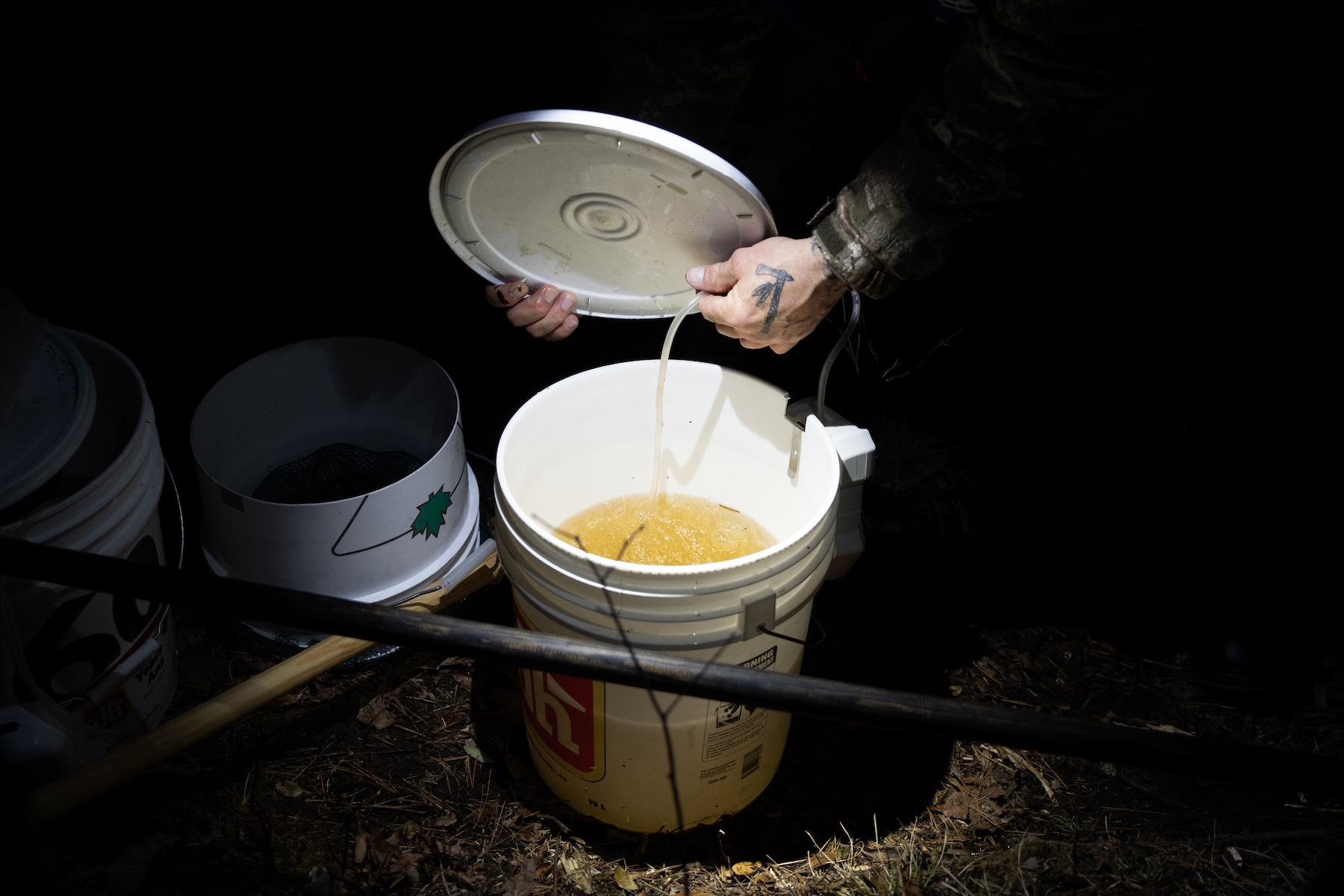
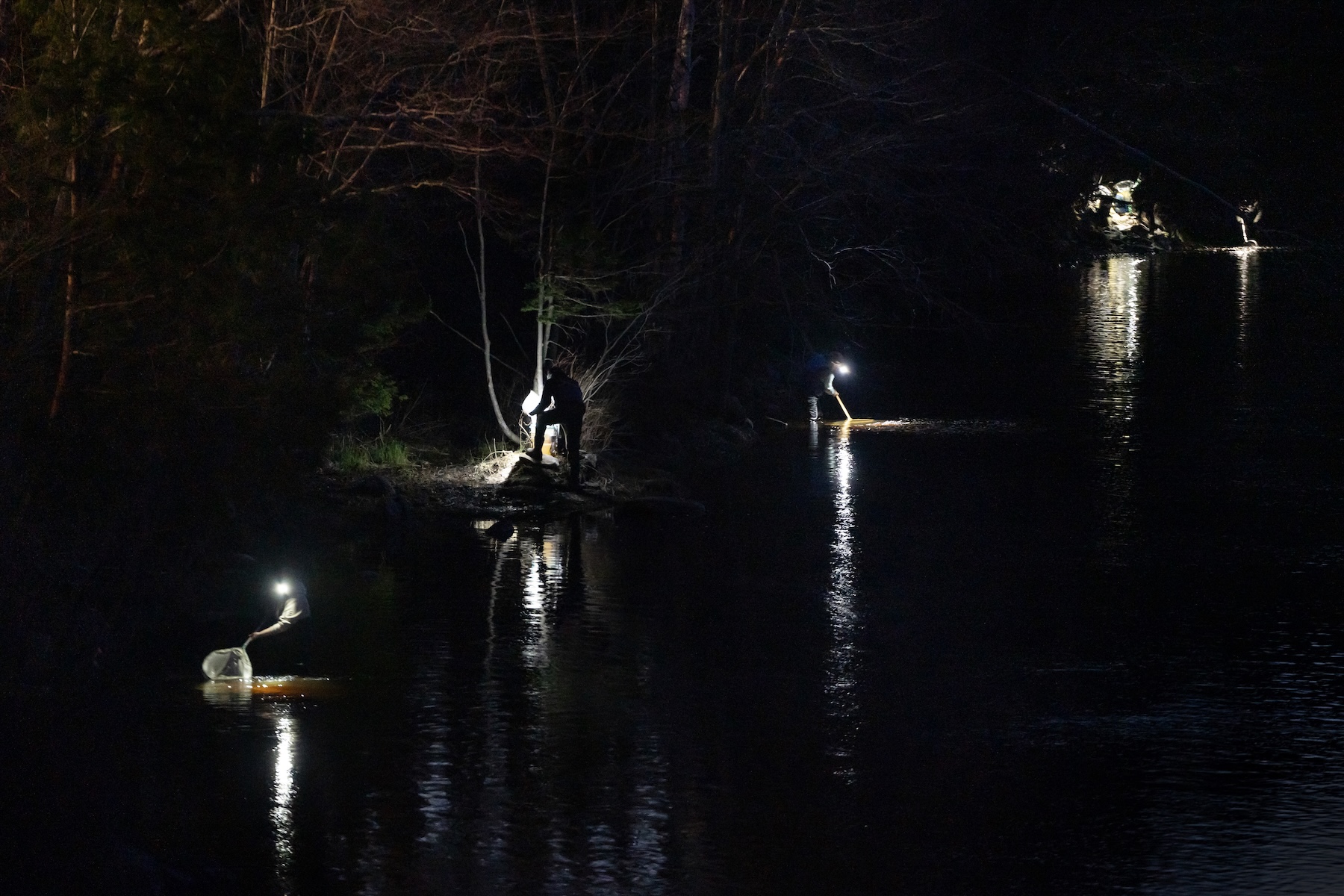
During the elver season, which typically closes on June 30 or when a total allowable catch (TAC) of approximately 10,000 kilograms is reached, Shelburne Elver’s roughly eighty fishers, or “dippers”—named for the long-handled dip nets used to scoop glass eels from water—split into groups and position themselves along twenty rivers where the co-operative is permitted to fish. They set up funnel-shaped fyke nets in estuaries and wait for the glass eels to swim up with the tide.
The captured elvers are placed in buckets, weighed on the spot, loaded into tanks on trucks, and driven to a facility. There, a manager will weigh again, and the information will be processed through an app and sent to DFO immediately. The live elvers are moved into tanks pumped with air. Profits are divided into seventeen shares, and each shareholder decides on the distribution to their recruited dippers. The elvers are packaged and shipped to the other side of the world—to be raised in commercial farms, predominantly in China, and sold.
In 2009, the Convention on International Trade of Endangered Species listed European eels as endangered, and the European Union banned glass eel exports the following year—which dramatically increased demand for American glass eels from the United States and Canada. The recorded price of the legal American glass eel in the state of Maine increased twentyfold, from just under $100 (US) per pound in 2009 to around $2,000 (US) per pound in 2012. According to research by Kenzo Kaifu and Hiromi Shiraishi of Chuo University in Japan, the trade in live American glass eels to East Asia increased from two tonnes in 2004 to 157 tonnes in 2022. In 2022, North and Central America accounted for 89 percent of all live glass eels exported to East Asia, with Hong Kong as the main transit point. That year, Hong Kong brought in 100.6 tonnes of American glass eels from Haiti, 43.4 tonnes from Canada, 12.7 from the United States, and 0.2 from the Dominican Republic.
“If there was so much demand for illegal eels coming out of Europe,” says Sheldon Jordan, former director general of Environment and Climate Change Canada’s wildlife enforcement program, “there was only a matter of time before you would get demand coming for American eel.”
DESPITE A LICENSING system and reporting mechanisms, Canada’s elver industry has attracted rule-breaking profiteers. Dippers from Shelburne Elver say poaching—unlicensed harvesters—didn’t become rampant until relatively recently, a few years after the price increased dramatically. Dippers often come across poachers along the rivers and have experienced verbal threats, but some say DFO rarely responds to reports.
“We called DFO,” says Tahja Goulden, a dipper for Shelburne Elver. “They said, ‘It’s 1 a.m. I’m home in bed. What do you want me to do?’” Goulden worked with her sister Thia Newell and their parents as a dipper team, fishing only in waters allowed under the co-operative’s licence. Even security cameras that the co-operative has installed haven’t deterred unlicensed fishers. Goulden’s mother, Marsha, who died last July, once had a phone call with another dipper who had confronted an unlicensed elver fisher, with the latter threatening to rape her daughter. “I get real paranoid when we’re at the rivers, because it’s three women, right?” Marsha had said.
In 2023, DFO received over 1,550 reports of unauthorized elver fishing. DFO briefing notes, obtained through an access to information request, disclose that in 2020 and 2023—years when the season was prematurely suspended—the combination of authorized and unauthorized elver fishing exceeded the TAC. In both years, the department ordered the closure of the season not just because overfishing threatened eel stocks but also because of frequent trespassing, violent threats, and armed incidents.
DFO says it has deployed additional enforcement officers to various locations and increased the number of patrols. But elver fishing is carried out at night, along more than 200 rivers in the Maritimes, often in remote areas difficult to access by vehicle. In a 2024 briefing note, DFO acknowledges that enforcement has proven insufficient to control illegal activities. Even after DFO declined to open the 2024 season that March, its enforcement officers seized elvers at a transport facility in Dartmouth as well as at Toronto Pearson International Airport, weighing approximately 169 kilograms, valued at more than half a million dollars.
Since the Marshall decision in 1999, many Indigenous people have relied on their right rather than provincial licences to fish, only to be accused of poaching. Across the Maritimes, disputes over the right to fish—particularly when expensive species like elvers and lobsters are involved—have repeatedly turned into violent conflicts, including the destruction of fishing facilities in Nova Scotia in 2020.
By September 2023, more than fifty Indigenous people were facing charges of illegal fishing in Nova Scotia, according to records compiled by Mi’kmaw journalist Maureen Googoo. In March 2024, the month before Nevin was arrested, DFO officers arrested two Indigenous men, dropped them off at a gas station, and left them to walk miles without shoes. The officer who arrested them received a ten-day suspension.
Tensions have been exacerbated by what some see as DFO’s mismanagement of the industry. Over the past few seasons, DFO has removed a portion of the annual TAC of commercial licence holders and assigned it to First Nations—a move presented as a way to integrate Indigenous fishers into the commercial system but seen by licence holders as unfair. The reduction of the quotas of licence holders—along with a proposed DFO pilot program that would have allowed individual dippers a share in the year’s TAC, essentially incentivizing them to break away from companies that once employed them—troubled many in the commercial industry.
“You’re dividing up the groups and pitting us against each other and making animosity,” a dipper told DFO staff in an online forum in October 2024. More people looking for elvers in the same waters would increase pressure on the resource. “Somebody’s gonna get killed. You mark my words,” said one dipper. “If you don’t police this, somebody is going to die.” A few months after the online forum, DFO dropped the pilot program.
Prior to his arrest that night in Dartmouth, Nevin was charged at least sixteen times under the Fisheries Act in six years, with most cases dismissed. In the 2024 incident, he wasn’t even actively fishing. “I was brutally attacked for no reason,” he says. “I know I didn’t do nothing wrong.”
Lawyer Michael McDonald, who initially handled Nevin’s case, said the original charges against Nevin included obstructing fishery enforcement under the Fisheries Act and two assault charges under the Criminal Code. But the prosecutor later dropped the fisheries charge and opted to accuse Nevin of obstruction under the Criminal Code, escalating what was originally a regulatory offence into a criminal charge—a tactic, McDonald says, that could raise constitutional concerns.
Anthony Davis, a professor emeritus in anthropology and sociology at Mount Saint Vincent University who has studied the socio-economic organization of North Atlantic fisheries, says policies like DFO’s early closures are driven by panic. “Shutting down and at the same time not assuring Mi’kmaq or Indigenous access is unconstitutional,” Davis says. “It’s illegal.”
Shelburne Elver’s dippers are panicking too. They have had to find various odd jobs to make ends meet when they can’t fish for elvers. Newell was considering going back to school for a diploma so she could increase her chances of getting a job, but she was afraid she would not be able to afford the tuition and would also lack time to take care of her children. Goulden says she may have to get over her seasickness and begin lobstering.

IN 2025, THE ELVER season opened in March. The TAC—9,960 kilograms, a number that has not changed in twenty years—was not reached, allowing fishing to continue until the end of June. The industry argues that DFO should increase the total to accommodate Indigenous fishers instead of redistributing quotas, while DFO says the number is set based on the best available scientific data to ensure the sustainability of the species.
Brian Jessop worked at DFO’s science branch for thirty-two years, beginning in the 1970s, and provided the biological basis for the commercial elver fishery’s establishment. He says, when quotas for licence holders were initially set in 1989, they were set arbitrarily and with the idea that they could be adjusted once there was enough data. Indeed, quotas were adjusted in 2005, but the TAC has remained stagnant since then.
It remains unclear how many elvers enter the Maritime provinces each year. The only elver index program that aims to track the size of elver runs, located on Nova Scotia’s South Shore, has been compromised in the past few years due to fishery closures because of illegal fishing. Jessop says setting up more monitoring systems elsewhere requires substantial resources and long-term commitments that have never materialized. “The amount of science being done by DFO is not as large as it might be,” Jessop says. With an inadequate amount of science, he says, there’s a lot more room for grasping and for hope to replace hard facts.
John Casselman, a biology professor at Queen’s University known for his decades of work on American eels, is disappointed by the lack of protection for the species. He says scientists presented research at a conference in 1997 about declining eel stock and suggested monitoring the elver population and setting a sustainable catch quota. Even though scientists were beginning to raise alarm bells by this point, policy makers did not implement these suggestions.
Casselman is particularly concerned about the eel population, arguing that DFO is not attaching importance to the reality that the American eel is at risk. “We used to have anywhere between 1 and 30 million eels in the Upper St. Lawrence River in Lake Ontario, and they’re gone,” he says. While dams, habitat loss, and ecological changes have all affected the vulnerable eels that rely on a single spawning ground, Casselman believes controlling the TAC offers the fastest way to protect the species. “You can’t harvest tons and tons of small glass eels,” he says. “If you harvest any component of the population, it has to affect its ability to re-establish, right?”
According to the most recent study on the American eel conducted by the Committee on the Status of Endangered Wildlife in Canada, in 2012, the maturing eel population in the Great Lakes and Upper St. Lawrence River area declined by 65 percent between 1996/97 and 2010, with significant population drops in some Maritime provinces too. The report named the American eels as threatened species, though they are not officially designated as such under the federal Species at Risk Act.
AFTER HIS 2024 ARREST, Nevin felt physically and mentally abused. His trial has been repeatedly postponed because he needed time to apply for legal aid. Nevin has started working again, as a heavy equipment operator. “I’m trying to keep myself busy,” he says.
Every year, the squiggling and squirming elvers will arrive once again in Atlantic Canada, and when the elver season opens next, dippers will be collecting their nets and flashlights and heading out to fish in the dark.

Yuan Wang is a reporter based in Halifax.

Darren Calabrese is a documentary and editorial photographer based in Halifax, Nova Scotia. Darren’s work has been recognized by World Press Photo, Pictures of the Year International, Communication Arts, Magenta Foundation, American Photography 34, and News Photographers Association of Canada.