Alysa Liu’s unlikely Olympic gold medal caps off a roller-coaster week in figure skating

MILAN — Alysa Liu never set out to be an Olympic gold medalist.
When she returned to figure skating after a two-year hiatus, she wanted to show the world what she could do, her creativity and her art, and who she was as a person.
Anything beyond that was simply a bonus.
But while it might not have been her intention, Liu will leave Italy with not one, but two gold medals.
On Thursday, almost two weeks after helping lead the United States to glory in the team event, Liu — the carefree California comeback kid with the bleached tree ring-inspired hair — became in many ways the unlikeliest of Olympic champions in women’s figure skating as she stunned with a flawless free skate performance and surged up the leaderboard to take over the lead.
Leaving the ice, she exclaimed excitedly to the camera: “That’s what I’m f—ing talking about!”
The 20-year-old Liu had to watch two more skaters compete, but it didn’t matter. In her mind, she had already won in every way that mattered.
“I don’t need this [medal],” Liu said later. “But what I needed was the stage and I got that, so I was all good. No matter what happened.”
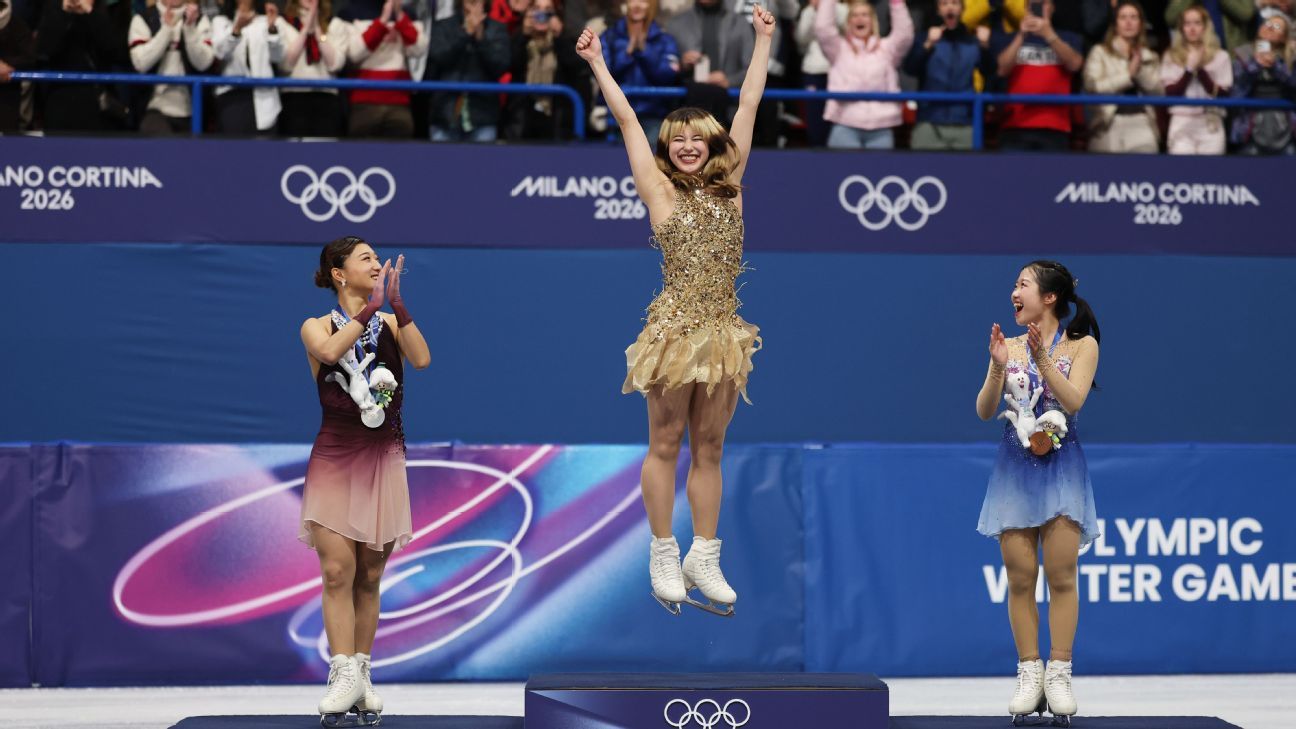
And when it was over, and Liu jumped up and down on the podium, she was not only the gold medalist but the first American woman to achieve the elusive honor since 2002 — more than three years before she was born. After a roller coaster of an Olympic Games for the American contingent on the ice, it was perhaps the most fitting and perfect of endings.
“I’m honored to be part of this [gold medal] club,” Liu said. “I guess it’s a club maybe, but no, I am really honored and they are incredible athletes. … I hope that with all this visibility I now have, I hope people don’t just look at a headline like, ‘Oh, she won a gold.’ I hope people really, I don’t know, take their time to read my story even though it’s not fully out. But one day it will be [and] on that day I hope to inspire even more people.”
After a staggering start to her career, including becoming the youngest national champion in history at 13 and reaching the Olympics as a 16-year-old, Liu retired from the sport following a third-place finish at the world championships in 2022.
“Heyyyyy so I’m here to announce that I am retiring from skating,” Liu wrote at the time in a since-deleted Instagram post. “I started skating when I was 5 so that’s about 11 years on the ice and it’s been an insane 11 years. A lot of good and a lot of bad but (you know) that’s just how it is.”
Having never experienced a normal childhood, or teenage years, Liu embraced everything non-skating life had to offer.
She hung out with her friends, enrolled at UCLA and even hiked to Mount Everest base camp in 2023, something that remains a favorite memory. She embraced her other interests, like dancing and music, and figured out who Alysa Liu the person was, and not just Alysa Liu the skater.
But a family ski trip reminded her of how much she loved to move and push herself physically to the limit. She returned to the rink. It wasn’t serious at first, not necessarily anyway. But she was surprised at how many of her skills remained. Soon she had fallen back in love with the sport. She recruited former coaches Phillip DiGuglielmo and Massimo Scali to help her yet again. Though this time, as they both agreed, everything would be on her terms and she had the final say in everything.
As part of that, they never set goals like winning Olympic gold medals. Liu wanted a place to showcase her creativity — she showed equal, if not more, enthusiasm for the dress she wore in her free skate when speaking to the media than she did the final result — and they never focused on winning. DiGuglielmo said he quickly realized in Liu’s first competitive season back in 2024-2025 that her short program and free skate had what it took to beat the best in the world, but they never talked about it.
When they arrived at the world championships last March, they focused on Liu getting the chance to show her programs, not what could happen if she did her best.
“At worlds, she won the short and we were like, ‘Done, goals achieved. We let her show this amazing short program,'” DiGuglielmo said Thursday. “They got [to see] the best short program in the world. It’s a win. Then it was, ‘OK, let’s do the free skate and just see how it goes.'”
Performing the same free skate that earned her Olympic gold, Liu won the 2025 world title. But even after that triumph, no one on Liu’s team spoke about specific goals for Milan. Instead, Liu just focused on doing enough to make the Olympic team so she could have a true Olympic experience after taking part in the pandemic-impacted Games in Beijing.
DiGuglielmo added that one of his and Scali’s priorities was simply giving Liu good memories.
“She was so not happy that she wound up compartmentalizing, putting that all somewhere in the back,” DiGuglielmo said. “She doesn’t remember that she went to junior worlds or that she went to the Junior Grand Prix Final. She doesn’t remember any of that. And so our tagline has been ‘Making memories.’ And we wanted to, everywhere we went, everywhere we go, we want to make memories.”
Smiling and joy, and savoring every moment, have been hallmarks of Liu’s return. Though she doesn’t like when people describe this chapter as “Alysa 2.0,” even her coaches think it’s applicable because “she kind of reinvented herself.”
She now prioritizes how she feels far more than results. When she watched Amber Glenn surpass her score at the national championships last month, she never stopped smiling.
And while others, including Glenn and fellow teammate and one-time men’s front-runner Ilia Malinin, succumbed to pressure during the Games and have spoken openly about the mental toll it and all of the attention can take, Liu never showed any such signs. During her three skates — once in the team event and twice in the individual — she never once appeared flustered or frustrated. She just looked to be someone who loved to skate and was doing it for themself.
She didn’t know it yet, but Alysa Liu’s spectacular free skate would win her Olympic GOLD. 👏 #WinterOlympics pic.twitter.com/LzMCkvwGMf
— NBC Olympics & Paralympics (@NBCOlympics) February 19, 2026
“She has this ‘Oh, if I want to do something, I guess I could just go try and do it’ quality about her,” Ashley Wagner, who helped lead the U.S. team to the bronze medal in the team event in 2014, told ESPN ahead of the Olympics. “It really is that simple. And the only thing that often gets in people’s way is themselves. And Alysa takes that rigidity of thought and just completely blows it away and shows up and delivers because she’s just skating …
“Her ‘Why’ is so pure. I work in sports psychology now and it’s so healthy to demonstrate to athletes that when you’re emotionally connected to your why, you see results.”
In an interview with ESPN last fall, Liu said everything she does at this stage in her career has a purpose.
“I’m so intentional now,” Liu said. “I’m so grounded. Everything I do has a reason for why I do it.”
No figure skating federation arrived in Milan with higher hopes than the United States.
At those world championships, less than a year ago, the country claimed three of the four titles in Boston and a massive medal haul in Milan seemed not just possible, but probable.
And it wasn’t just the victors from that event — Liu, Malinin, Madison Chock and Evan Bates — that had fans excited. All three American women finished in the top five — something that hadn’t happened since 2001.
Isabeau Levito, who won silver at the 2024 worlds, came in fourth. Glenn, who had been among the favorites entering the competition after a previously undefeated season including winning the Grand Prix Final title, rallied for fifth after struggling in her short program.
Top spots on multiple podiums seemed like a near certainty after an incredible national championships in January.
Of course, as so often happens on sports’ grandest stage, everything didn’t go to plan. Far from it, in fact.
First there was an up-and-down team event. Malinin had a nervy short program, as did Glenn in her free skate, and the Japanese team were formidable foes.
But ultimately, largely thanks to Liu’s strong start, Chock and Bates’ unwavering consistency in the ice dance competition and a clutch pairs free skate performance by Ellie Kam and Danny O’Shea, the U.S. ever-so-narrowly ended up with the gold medal. The one-point margin separating the U.S. and Japan was the smallest deficit in the event’s history.
Alysa Liu is in her element in her short program on the Olympic ice. 😍 pic.twitter.com/prbAVw1OlQ
— NBC Olympics & Paralympics (@NBCOlympics) February 6, 2026
It seemed like another sign of good things to come for the Americans. But one day later, Chock and Bates came in a stunning second place in the rhythm dance segment of the individual event. Despite controversy and global speculation about unfair judging, they earned the silver medal. As the three-time reigning world champions, it was a shocking result — and the two couldn’t hide their disappointment.
However, that podium surprise was quickly overshadowed as Malinin, the leader after the men’s short program, imploded during his free skate. After landing his first quad jump, the 21-year-old bailed out of his famed quad axel in the air and soon after completely unraveled, doubling a quad loop and falling twice. Prior to the Olympics he hadn’t lost a competition since 2023. He ended up in eighth place.
He told reporters after his skate he was flooded with negative thoughts at the start of his program and simply couldn’t recover.
The pairs competition didn’t fare any better, although that was expected as a relative weak spot for the country in recent years. Emily Chan and Spencer Akira Howe came in seventh, and Kam and O’Shea finished in ninth.
But it all led up to the sport’s final event, and its crown jewel, the women’s singles competition.
After weeks of hype, social media fan edits and even a Taylor Swift-narrated promo video, the self-nicknamed “Blade Angels” were ready to take the stage. All three were skating in the final group during the short program, and each with the chance of ending the country’s 20-year medal drought in the event.
Liu had a strong start for the trio, showcasing her artistry with a near-perfect skate and a breathtaking performance. Levito followed with a clean and, in her words, “elegant,” program that wowed the crowd but didn’t score highly, landing her in eighth.
And Glenn, skating in the penultimate position, looked poised for medal contention as she landed her opening triple axel. But she later doubled her planned-triple loop, resulting in it being deemed an invalid element and earning zero points for it. Her devastation was immediately apparent. She cried while waiting for her score. She received a 67.39, putting her in 13th place.
Liu told reporters she was disappointed for Glenn, a close friend.
“She’s overcome a lot, and I just want her to be happy,” Liu said. “That’s genuinely all I want. And so I’ll be seeing her later. Don’t worry guys, we stick together.”
Entering the free skate, Liu was in third place and just over two points out of the lead. Levito was in eighth. The trio of Japanese skaters made up the rest of the top four, and Russian enigma Adeliia Petrosian — who had minimal international experience but teased a quad jump — was in fifth.
Glenn set the tone on Thursday with a redemptive, high-flying and high-scoring, performance which catapulted her to an early lead, where she remained until the final four skaters took the ice.
But it was Liu, and her disco-themed program set to Donna Summer’s “MacArthur Park Suite” skate that had nearly everyone in the arena, including a supportive Malinin, on their feet by its conclusion. With her season’s best score of 150.20, for a 226.79 total, she claimed the top spot in the standings, and guaranteed herself a medal, with Kaori Sakamoto and Ami Nakai left to compete.
There was no apparent worry or envy for Liu as she watched both of the final skaters. Instead she clapped along and stood excitedly in celebration when they were both done. But when Nakai’s score was announced, it was Glenn, who finished in fifth place, who grabbed Liu’s hand and held it up in victory.
It was a moment that embodied the journey of the American figure skating team as a whole. It seemed a victory for one was a victory for all, and Liu — the antithesis of the “ice princess” stereotype that has plagued the sport for so many years — was simultaneously the most surprising and fitting person to get everything back on track.
While it wasn’t exactly the outcome the country had hoped for overall, and Japan won more medals across the five skating events than the U.S. did, it still marked a return to form on the sport’s highest stage.
After worlds, and following the enthusiasm after the national championships, it was supposed to be a moment for figure skating in the country, a renaissance harkening back to the glory days. While skaters of past generations were household names, the sport has waned in popularity. Malinin in particular, with his impressive athleticism and an almost-parkour style at times, looked as if he could be a crossover star, as well as bring in a new generation.
In the end, it was Liu who ended up in the middle of the podium and who will likely become a national superstar in the coming days and weeks.
But through her triumphant tale of return, as well as the candor and vulnerability of Malinin, Glenn and Chock and Bates in defeat, and the camaraderie displayed by everyone in the American contingent throughout the Games, it might have done something even more important.
“Her story of taking a step back, mental health — I think it really attests to you never know what the journey to success is going to be,” Glenn told reporters. “I really hope that can reach the skating community, that it’s OK to take time.”