 11
11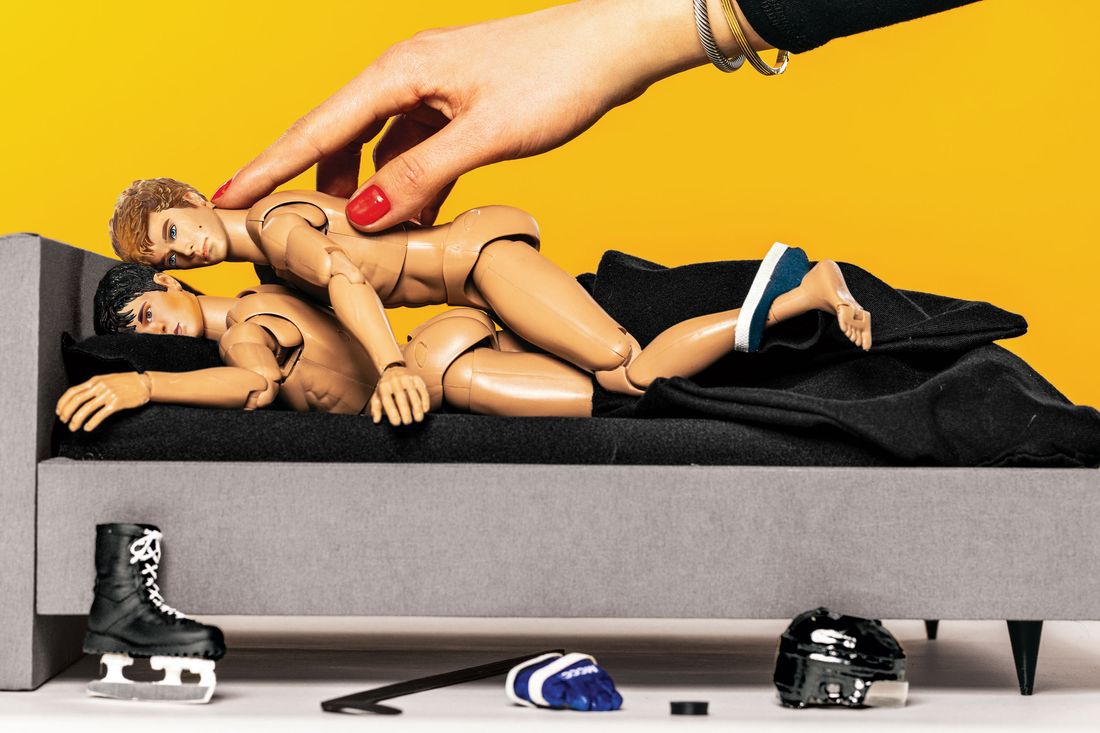

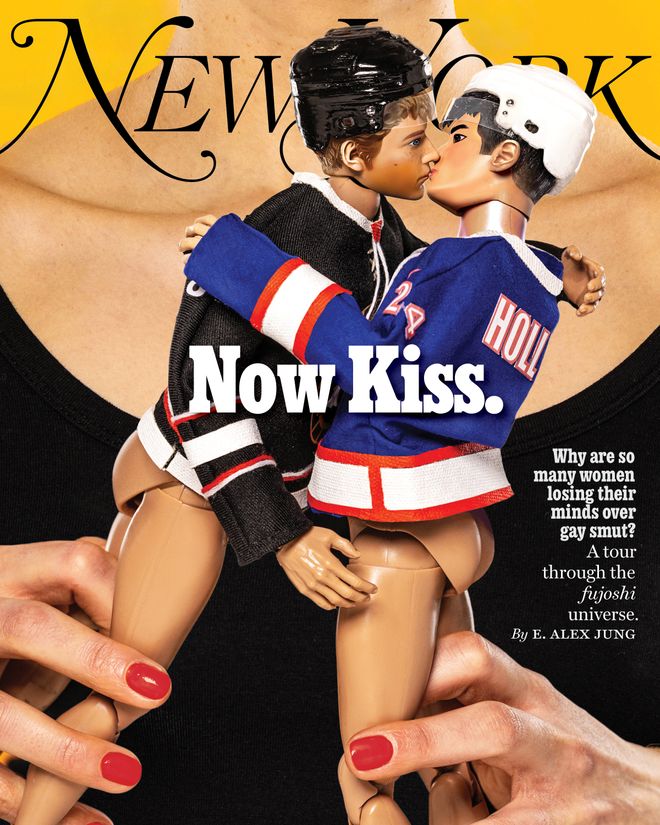
Photo: Elizabeth Renstrom for New York Magazine
We can now look back on November 28, 2025, as the start of a mass-psychosis event. In an era of neo-puritanical television slop, a fresh, horny breeze swept in from Canada: Heated Rivalry, a six-episode series about two professional hockey rivals turned lovers, Shane Hollander and Ilya Rozanov, stirred something deep in the American psyche. Ordinary taxpaying adult women, many of them my friends, suddenly lost control of their faculties over “the gay hockey show.” “Dude, I have the sickness,” wrote one. “I don’t like men,” said another. “I don’t understand why I’m so drawn to them.” The most common reaction to watching it for the first time was either to watch it again or to go to the source material: a six-book series by Rachel Reid called Game Changers. The memetic experience was re-created online through fan edits, reaction videos, and scenes restaged in Animal Crossing. Every day brought a new, heightened level of fervor at dance parties, look-alike contests, and spin classes. People were learning Russian because Ilya speaks Russian. “I put myself fully offline for the month of December and missed the entire life cycle of Heated Rivalry airing in real time,” says Casey McQuiston, the author of the gay romance Red, White & Royal Blue. “I came back and was like, What the fuck is going on? What’s happening to the American audience is truly ‘If you give a Victorian child a Doritos Locos Taco.’”
The sight of Shane and Ilya kissing had awakened a libidinal desire in many women, both heterosexual and queer, like an army of sleeper-cell agents hungry for more. “I can’t actually figure out what’s happening to me,” says Arielle Angel, the editor of Jewish Currents. “I’m just having a midlife crisis where I’m like, I’m never going to feel these feelings again.”
I found their madness as intriguing as they did. Why gay men? Most of the gay men in my life were watching too, but our passions were muted and pedestrian by comparison. There was a clear line of desire, whereas for women, something queer was happening, like pegging a straight guy. This was a fugitive sensibility with a shroud of shame around it. Everyone had their theories: because of the yearning; because women are the primary consumers of romance anyway; because there’s no gender imbalance; because something trans is going on; because of heteropessimism; because, well, what’s better than one dick?
See All
There’s a word for this in Japanese: fujoshi, often translated as “rotten girl,” a reclaimed pejorative for women who love men who love men. In Asia, the genre is known as BL (“boys’ love”), an umbrella term sometimes called yaoi that can run from the chaste to the pornographic. In the West, it’s called M/M (“male/male”) romance. BL and M/M romance have separate yet parallel histories; both began as a cooperative female fan culture in which women would make canonical texts gay for one another. BL has since evolved into its own commercial industry in Asia with several boom cycles in manga, anime, and live-action TV shows and movies across the continent — in Japan, Thailand, South Korea, China, Taiwan, and elsewhere. Meanwhile in the West, M/M romance has remained mostly in the basement of pop culture on fan-fiction forums and in e-books. Through Heated Rivalry, what was fringe has finally broken loose. The fujoshi switch has been flipped, and now everyone’s fujoing out.
In order to understand Heated Rivalry, you must understand slash fiction.
In the late ’60s, a Star Trek fan named Jennifer Guttridge wrote a story inspired by the show’s season-two premiere, “Amok Time,” in which Spock (Leonard Nimoy), the diagonally browed half-Vulcan, enters pon farr, a state of sexual madness that afflicts Vulcan men every seven years until they “mate or die.” Guttridge’s telling, titled “The Ring of Soshern,” begins like an episode might: Captain James Kirk (William Shatner) and Spock are exploring an Earth-like planet when a storm maroons them, preventing a return to the USS Enterprise. As they look for food and shelter, battling dinosaurs and protohumans, Spock’s behavior grows increasingly erratic. The secret he keeps from his captain is that he has entered pon farr. Over the course of several pages, both the captain and his first officer come to realize there’s only one very obvious solution to the problem.
“The Ring of Soshern” was an early, legendary piece of Kirk/Spock slash fiction (named for the slash between their names) that still exemplifies the genre: a homosocial world without women in which platonic chemistry turns romantic. Kirk/Spock was the ship that launched a thousand ships. Over the ensuing decades, K/S slash fiction would grow in scale, starting as conversations that became chain letters and eventually zines. Women formed a “Spock Underground” where they wrote Vulcan erotica. “We would circulate (via snail mail!) hard-copy K/S stories (& other Vulcan fantasies …) to each other for private reading and critiques because at that time none of the Trek fanzines would touch sexual stories,” said one writer. To the average Star Trek fan, K/S slashers were perverting the fandom with what one critic called their “unnecessary excursions into human sexual abnormalities.”
There are, broadly, two kinds of fans: the affirmational and the transformational. (They can overlap.) The affirmational fan is the one who obsesses over the facts, details, and rules of a given world. They might learn Klingon grammar, map out Tatooine, or say things like “Well, the concept of ‘rape’ doesn’t exist in Dothraki culture.” They are the originalists of what is “canon” and the foot soldiers of the author, who is always right. They are often coded as male (think Comic Book Guy from The Simpsons). The transformational fan is the one who identifies a crack within the text to fix or to insert their own desires. “It’s largely a democracy of taste,” writes obsession_inc, who first put forth this framework. “Everyone has their own shot at declaring what the source material means and at radically reinterpreting it.” The “favorite problem to fix” is usually a lack of sex, which is why most fan fiction is a form of slash fiction. Writers project parts of themselves into the characters, things that often have to do with their own bodies, sexual desires, and vulnerabilities. Finding others who share those feelings is its own affirmation. “Transformative fiction is so personal because it feels like a life raft,” says Ngozi Ukazu, the author of a 2013 gay hockey romance called Check, Please! “You’re adding a little piece of yourself into it, even if it’s just an opinion on how the world works.” Interestingly, most slash is M/M: On Archive of Our Own, better known as AO3, the major hub of fan fiction today, M/M ships made up 83 out of 100 top entries as of mid-2025.
In the U.S., the rise of fan fiction was contemporaneous with another form of écriture féminine: the mass-market romance paperback. In 1972, Kathleen E. Woodiwiss published The Flame and the Flower — a historical romance in which the powerless heroine is raped by the hero and saved by eventually marrying him — selling over 2.3 million copies in four years and helping to set the template of the “bodice ripper” for the next 25. Fan fiction borrowed many romance tropes such as “enemies to lovers,” “forced proximity,” and “huddling for warmth.” The obvious difference with M/M slash was the removal of heterosexual violence. “Having two dudes falling in love means you don’t have to inhabit the exhaustion of the woman’s point of view,” says Candy Tan, co-author of Beyond Heaving Bosoms: The Smart Bitches’ Guide to Romance Novels.
Around the same time in Asia, BL emerged; it was influenced by postwar Japanese literary trends, including the rise of shojo (girls’ manga). Women formed their own manga circles and began to self-publish work called doujinshi, which could include homoerotic spins on popular shonen (boys’ manga) like the soccer series Captain Tsubasa. Yaoi, the popular term then, comes from an acronym of “Yama nashi, ichi nashi, imi nashi,” meaning “No climax, no point, no meaning.” Akiko Hatsu, a member of the manga circle Ravuri, said at the time, “It’s true that this manga has no climax, no point, and no meaning. But there’s something — what’s going on between these guys?” BL became an overarching genre term by the mid-’90s with dedicated sections in bookstores and an entire street of BL shops called Otome (“Maiden”) Road in northern Tokyo. The term fujoshi entered the lexicon via the message board 2chan by the early aughts, initially as an insult against the women obsessed with BL. Japanese media focused on extreme cases of women who were so addicted their everyday life had been derailed. “We the fans were quick to adopt the term ourselves with a sense of proud ‘shame’ to be different,” says Akiko Mizoguchi, a professor at Waseda University who runs a YouTube channel called BL With Akiko.
Meanwhile, throughout the ’80s and into the ’90s, slash continued to flourish underground in the States. The buddy-cop genre (Starsky & Hutch, The Professionals, Miami Vice) and crime dramas (Wiseguy) were ripe for the ficcing. Then the internet happened and, with it, existential questions. “We are no longer so exclusive, so secret, so special,” wrote one slasher in 1998. Slash exploded online, taking root in spaces like LiveJournal, Fanfiction.net, DeviantArt, Wattpad, Tumblr, and AO3. It took weirder and wilder shapes. It could be anything: dirty, deranged, damaged, funny, stupid, extremely horny, heart-stoppingly earnest. Websites developed tags around fandoms, couplings, style, and subgenre. Popular ships included Draco/Harry (Harry Potter), Castiel/Dean (Supernatural), and, lately, Buck/Eddie (9-1-1). There was angst, “hurt/comfort” (a character suffers only to be cared for by another), slow burn, body swapping, AU (alternate universe), crossover (X-Men meets anthropomorphized My Little Pony), incest, sexual assault, and the Omegaverse, a subgenre in which men can get pregnant (known as “mpreg”).
The introduction of reading tablets like Sony’s Reader and the Kindle in the aughts spurred the next shift: the anonymity of the e-reader allowed seamless access to the smuttiest texts. Most important, writers could self-publish. “When we talk about who was the first to do queer romance, it’s people going absolutely sicko mode in the e-book format,” says McQuiston. The wall between fan fiction and traditional publishing grew more porous, eventually collapsing with E. L. James’s Fifty Shades of Grey, the most successful book series of the 2010s, which began as Twilight fan fiction. Traditional publishers took to what’s commonly called “filing the serial numbers off” fan fiction. For instance, slash fiction about, say, Sherlock Holmes and John Watson could avoid copyright violations if you gave them different names and made them surfers in the ’70s. Publishers have been mining M/F fan fiction — last year, three Draco/Hermione books hit the best-seller list with newly refurbished identities. Throughout the 2010s, gay YA romances slowly made inroads too: Becky Albertalli’s Simon vs. the Homo Sapiens Agenda was published by then-HarperCollins imprint Balzer + Bray; Alice Oseman’s web comic Heartstopper’s popularity online led to Hachette publishing it in 2019.
Hockey slash fiction was simultaneously coming into its own as part of a subgenre called real-person fiction (RPF), in which fans would ship actual celebrities; suddenly, Harry Styles and Louis Tomlinson are doing it doggy during their world tour; Jung Kook and Jimin are kissing backstage. Hockey RPF had in part grown out of “bandom” — an RPF centered on My Chemical Romance, Panic! at the Disco, and Fall Out Boy. All three groups were either going on hiatus or shedding members in the early 2010s, and a number of fanfic writers switched to hockey. There are a couple of theories about why hockey. Its seasons have similar rhythms to a band on tour — there are 82 games in a regular season, which means long days on the road with a lot of sweaty man time together. The real reason may be simpler and more American: Romance is still dominated by white authors, and hockey is a white sport. “Every other major American sport is majority people of color,” says Tan. “Hockey has a lot of traditionally handsome white bros, and people are into it.”
A generation of American kids growing up in the ’90s and aughts were also consuming more anime and manga and, by extension, shojo with BL elements. Illegal fansubs would translate and disseminate Asian media through the West. Clamp, an all-female manga group, wrote popular works like the dystopian Tokyo Babylon, featuring a toxic, sublimated romance between two boys. The 2016 anime adaptation of the BL manga Yuri!!! on Ice, about a male figure skater and his coach, became a crossover hit. Slowly over the past decade, the term fujoshi traveled west. In 2023, a tweet of Meredith Grey longingly watching two men make out that read “meredith grey fujoing out” went viral. “I genuinely think that is where the resurgence came back,” says Summer Farah, a doctoral student in literature and creative writing and longtime Supernatural fandom member.
A fujoshian gaze was circling in polite society, too: See Zendaya watching Josh O’Connor and Mike Faist kiss in Challengers or Hanya Yanagihara’s A Little Life, which reproduces many of the classic tropes of slash, from “hurt/comfort” to “gay for you” (in which a straight man happens to fall in love with a man). Readers wondered aloud if it began as Marauders (Harry Potter) fan fiction. By the time Heated Rivalry premiered, the American fujoshi had a new community to welcome.
I am deep in the heart of Heated Rivalry country at Cassette, a cocktail bar in Toronto, on a wintry January evening with 60 hardcore fans. We are here for trivia night. Some have watched the show more than 20 times, and one team of friends got tattoos of their favorite lines — GIMME KISS; YOU DESERVE SUNSHINE — earlier that afternoon. The crowd ranges from elder Gen Z to millennials and is made up almost entirely of women and queer people with a handful of gay men like myself. Rachel Reid, the writer of the books, is to my right, sipping a “Hole > Peg” (a margarita, basically) alongside her childhood best friend, Monique, and a newly hired publicist. Her appearance here was a surprise — this is one of 14 crowded trivia nights at the bar — and has elicited the appropriate levels of excitement for an author, i.e., screaming but respectfully. She is the wise and benevolent arbiter who can answer all their questions. Like, who fell in love first on the show: Ilya or Shane? (Ilya, and it happened when Shane started folding his clothes.) Are their jersey numbers a numerological way to spell out 69? (No, she sourced Ilya’s No. 81 from her authors’ Discord because it looks like the word BI for “bisexual.”)
Reid was born Rachelle Goguen in the Halifax suburbs, where she lives with her husband and two kids across the street from her childhood home. She’s on the upper cusp of the millennial experience at 45. As a kid, she was obsessed with comedy and hockey. “I always wanted to be a boy, so I was really trying to fit in with the boys,” she says. “I thought if I knew the most about hockey, that would make the boys like me. They did not like that.”
After college, she joined a burlesque society in the city. “It was my Rocky Horror Picture Show moment without the killer aliens,” she says. “You saw this other world, and you’re like, Oh, these are the people I want to be with. I want to be like these cool, interesting, artsy, queer people.” Her stage name was Miss Conduct, and one of her routines was a striptease getting out of hockey gear; in another, a hockey stick was her scene partner. “It was getting fresh with me, and I’d slap it,” she says. That’s where she met her husband, Matt Reid, who was the pianist for the show. When she was 27, she started an M.B.A. at Nova Scotia’s Saint Mary’s University on the logic that “I can be the person who helps everybody make money,” she says. “I knew day one that I’d made a huge mistake.”
Throughout her life, Reid had loved comic books. She worked at a local comic-book store and started a blog in 2006 called Living Between Wednesdays. She preferred the DC Universe over Marvel, including Smallville, the Superman show starring Tom Welling that she was into even though she thought it was bad. That failure, of course, made it perfect for fan fiction, which was her foray into the genre. “At first, I was like, Oh, I’m not going to read the smutty stuff, but then inevitably I read the smutty stuff and I was like, Oh, this is great.” She liked Clex (Clark/Lex), an enemies-to-lovers setup “that wrote itself.”
She and Matt got married in 2008, and the next summer, she was pregnant with her first child. They moved back to the same street she grew up on, and she began working at a merchandising company (where she still works). “We were the only ones with babies, so we lost touch with the cool people doing the cool stuff,” she says. “I started writing romance novels because I needed an outlet. It was something I was doing on my iPad, sitting on my kid’s bed, waiting for them to go to sleep. It really did come out of just boredom and sadness.”
Reid began writing what would become her first book, Game Changer, in 2013. It featured a romance between Scott Hunter, a hockey player who is extremely disciplined about staying in the closet until he meets Kip Grady, a smoothie-shop employee whose concoctions help snap him out of a slump. Reid, looking for feedback, reskinned the story as Steve Rogers/Bucky Barnes (Stucky) fan fiction — also known as the characters Captain America and his sidekick from Marvel Comics — and posted it on A03. “I just needed somebody to tell me it was fun to read,” she says. In this version, Captain America is the captain of the New York hockey team (and, yes, of Team USA at the Olympics).
She got the idea for the second book, Heated Rivalry, after watching a documentary about the real-life rivalry between Russian Alexander Ovechkin and Canadian team captain Sidney Crosby (they are not lovers) — a move that is classic Hockey RPF. The books’ slash-fiction influences are not something Reid volunteers until asked, though the AO3 community still holds on to the Stucky receipts. “I’m embarrassed talking about it. I’m not really a fanfic author, so I feel like I used the fans of the fic,” she says. “I got positive feedback on it, and that gave me the confidence I needed to submit it to publishers.”
Boosted by the experience, she changed the names of Steve and Bucky back to Scott Hunter and Kip Grady and, in 2017, submitted Game Changer to two publishers, including Mackenzie Walton, a freelance editor at Carina Press, Harlequin’s digital-first imprint. Walton recognized Reid’s name from her comic-book blog and asked her to revise and resubmit. “There were little details that were still kind of fanfic-y. I wanted to make sure to get the serial numbers sanded off more because, personally, when I can tell a book used to be fanfic, I find it very distracting,” says Walton. “The whole book becomes, like, Who’s this character? Is this character really some other character? ” Game Changer was published as an e-book and became the first of a longer series called Game Changers (with an s), in which each book is a stand-alone romance in an ever-expanding gay hockey universe.
Regardless of its origins, the book series, particularly early on, reads like slash fiction. In Heated Rivalry alone, there are a dozen vividly imagined sex scenes that have a woman’s touch. The word slit (the front, not the back) appears nine times — each one a jump scare for this gay male reader — such as “tonguing the slit” or “sliding his thumb over his slit” (ouch). The narration unfolds in a hyperclose third person that alternates between the two characters, detailing every misunderstanding, heart skip, and neurotic thought, and the prose favors maximal pleasure with minimal effort — one-word sentence fragments, a heavy use of italics, and love of the word fuck. For instance, this is a moment from Shane’s point of view after another sexual encounter with Ilya:
There were too many things to process. Ilya Rozanov had gotten him off in a hotel room. Again. Ilya Rozanov wanted to sneak out of his team’s hotel the next time they were in Montreal (next week!) and meet Shane at his apartment so he could fuck him.
Ilya Rozanov wanted to fuck him.
Shane was both terrified and undeniably aroused by the idea. Undeniably extremely aroused by the idea.
But that didn’t change the fact that it was a really, really bad idea.
The Game Changers series is part of a fanfic genre known as “fluff and smut” that is equal parts horny and romantic. Literary scholar Elizabeth Woledge called this “intimatopia,” a distinct feature of M/M slash in which emotional intimacy and sex are woven together, often during an “intimate adventure” (e.g., exploring a planet). Romance itself begins with a social pact between the writer and the reader. It demands surrender, asking the reader to submit to its rhythms with the promise of a happily ever after. The books are Reid’s cottage, where the reader knows they will be safe. This relationship is reflected in the courtship between her characters. The protagonists are good, hot men, deserving of the love that comes their way. The sex is never disappointing, hurtful, ugly, or shameful. It is kind and oriented toward monogamy. Sex is the great equalizer. The smoothie man gets to have his hockey god, and the hockey god’s desire for the smoothie man brings him down to the mortal plane. He yearns like the rest of us.
The fantasy is as much social as it is sexual. In the fifth installment, Role Model, there is a Me Too scandal, during which the protagonist, Troy Barrett, calls out his former best friend, Dallas Kent, after credible sexual-assault allegations surface against him. Troy gets traded to the worst team in the league in Ottawa (which is also where Ilya now happens to play to be closer to Shane). He harbors his own secret (you guessed it!) and falls for the cute ball of sunshine Harris Drover, the team’s social-media manager. The arc involves Troy learning to be the man he wished he could be, including speaking up for victims of sexual assault. The book ends with Dallas getting arrested and Troy coming out.
“The most unrealistic thing in the books is Dallas getting arrested and not playing again,” says Reid. If there are clear villains in the books, they are invariably straight men, like Dallas or the league commissioner, which stems from Reid’s own disappointment with the NHL as an institution. There are still no out players, and some NHL teams recently stopped doing Pride Nights — during which players used rainbow tape on their sticks — after some players refused to go out on the ice. The reality is that someone like Dallas would get a slap on the wrist and return to the sport, “just like what’s happening now,” Reid says. In 2025, five Canadian players were tried for the alleged gang rape of a woman in 2018 while playing for the country’s world junior hockey team. (They maintained their innocence.) The trial ended with their acquittal. “That’s the real culture of hockey in Canada,” says Reid. “What I wanted to write about specifically was homophobia and toxic masculinity, and hockey’s a good arena.” This is all valid and admirable, but why eight — soon to be nine — gay hockey romances with such detailed, breathlessly written sex scenes? “I don’t know. I wanted to write a joyful queer love story, I guess,” she says. “I should get these thoughts hammered out. I’m between therapists.”
Heated Rivalry met us at a very unsexy time in our lives. We’ve been told the kids are scared of sex; Marvel films have turned Hollywood sexuality into an aesthetic without eroticism. However, it may be more accurate to say that hetero romance wasn’t doing it for some people anymore. That it’s harder to suspend disbelief in a post–Me Too, post-Roe, Epstein-filed, manosphere-poisoned real world where heterosexual male power has no bounds. That a straight man would know how to communicate his desires and ask about yours, to say “I like you. I want this to happen. Does this feel good?” — while also being hot and laying down pipe — would feel too far-fetched. If romance is an escape from your problems, why read about straight men?
Put another way, M/M romance is a genre solution to the problem of heterosexual men. (The rise of monster smut is a tandem attempt to sidestep straight men by turning the beast love interest into a “living, breathing sex toy,” my colleague Emily Gould tells me.) Romance readers are mostly women, and with M/M romance, there can be enjoyment without fear. There is no forced identification with a female character. There is no Bechdel Test to fail, no humiliation to endure, no experience or body to match up against one’s own. It allows the pleasures of romance, its stutters and starts and total incandescence, to unfold in a pure, uncut state. “When I read straight romances, sometimes it takes me out of the story because I’m like, No straight man will ever do this. Most straight men are not going to stand up to their friends when their friends are being jerks,” says Joanna, a longtime reader of romance novels. “With M/M romances, obviously I can’t relate, but the romance is stronger.”
Why not take men out of the equation entirely and write about a women-only utopia? “Straight women are much more likely to read a book about two men who they could conceivably be attracted to than two women who they’re not,” says Leah Koch, co-owner of the romance bookstore the Ripped Bodice. The reasons some queer women have found themselves drawn to M/M over F/F romance are not so different — fantasies about sex between two women still have the ick of the male gaze. “I think it’s mostly internalized misogyny,” says Farah. “It is a difficulty of imagining women’s stories without men.”
Another way of viewing a show like Heated Rivalry is as equality porn: Shane and Ilya are at the apex of a masculine sport in which one is constantly trying to one-up the other. “How many story lines do you see where it would be a king flirting with another king, as opposed to a king flirting with Cinderella?” says Joy, a 26-year-old university administrator. “Both of these men are at the top of their field, giving up societal power and reputation for love and feelings,” says McQuiston. “And I think that’s something we’re all taught that powerful men can never do.” It is a fantasy of power, of imagining the corridors of masculinity behind the curtain. The worlds of M/M romances are often all-male environments — the lovers are athletes, soldiers, cowboys, Mafia dons, frat bros. “They come off as very masculine,” says Joy. “For me, gay sex sometimes is the most masculine thing you can do because there’s literally no women around.”
If M/M romance begins from the place of building an ideal man, part of the dream is to be able to watch him learn how to be vulnerable. “Somebody has to be the first one to open up,” says Molly, a Canadian hockey mom and fan-fiction writer. “If they’re both men, then it’s like, Oh, I get to watch a man have to figure out how to articulate feelings. I’m just so into watching people have that realization of I’m in love with somebody.”
What remains is “a real question of identification,” says Angel, the Jewish Currents editor. “For me, Who am I? I mean, I’m definitely not experiencing myself in the sex scenes, but I’m still turned on by it.” For heterosexual women, the distance creates an erotic voyeurism that is both familiar (one dick) yet alien (two dicks). Others experience a diffusion, identifying with both characters. Rio Otomo, a professor in film studies, writes that reading and writing BL “provokes desire in multiple directions … I am, thus, autoerotic, but my (female) body is erased in this process.” The first two episodes of Heated Rivalry in particular are a feast of the male body — nipples, abs, hockey butts. “I am not a man. I am not a gay man,” says Joy. “I don’t know what it’s like to have my prostate stimulated, so I’m just going to believe that it feels good.”
For the women I spoke to, all the theories fell short of explaining what was happening to them — of capturing the visceral, all-consuming experience. There are as many reasons for people to love the show as there are people. Hannah, a reproductive-health clinician who had a baby about a year and a half ago, is still in the trenches of post-partum life. Watching the show lit a small flame. “I was wondering if I was asexual and past that part of my life,” says Hannah. “The show made me be like, Oh no, I’m not done. It’s been a helpful reminder of my old self.”
Molly describes the feeling as “tickling the unconscious.” She raises Carl Jung’s theory of the animus, which represents the masculine side that exists within every woman. For some M/M authors, writing and reading gay romance is a safe way to explore their own trans or nonbinary identities. “It’s easier to write about not you, but near you,” says Jun Cullinan, a nonbinary author of M/M romance. (Their pen name is Heidi Cullinan.) Aiden Thomas, author of Cemetery Boys, the first novel about trans characters by a trans writer to hit the New York Times best-seller list, started out reading and writing slash fiction (X-Men’s Iceman and Pyro). “It was through it that I started to think about my own gender,” he says. “A real red flag — or green flag — should have been that I was only ever writing male characters.”
McQuiston came out as nonbinary after publishing their first novel, Red, White & Royal Blue, a romance between the First Son of the U.S. and a U.K. prince. “What drew me to writing from the perspective of men was always gender exploration,” says McQuiston. “I think there are a lot of fans, whether they realize it or not, who we could check in on two years from now after season two of Heated Rivalry, and they’ll be at the pharmacy picking up their T.”
Soon after Heated Rivalry’s premiere, the girls started fighting. A minority of gay men were annoyed, maybe resentful, that this story about gay men had broken out in the mainstream, asking questions like “Do women love Heated Rivalry too much?” Some complained that the show was basic and mediocre and the obsession had gone too far. A familiar line of critique emerged: that it was an unrealistic depiction of gay life. The author Alex Toledo wrote, “It’s clear that whoever wrote it did not fully immerse themselves in the gay (or LGBT) experience and simply let themselves be carried away by their own fantasy.” On the front lines of haters was Jordan Firstman, the gay comedian and star of HBO’s I Love LA, who said in an interview with Vulture, “I watched those first two episodes of Heated Rivalry, and it’s just not gay. It’s not how gay people fuck.”
Collisions spilled out into the real world. Rumors swirled that a gay man in Utah was kicked out of a Heated Rivalry watch party at a bar because some women felt uncomfortable with his presence. Depending on the event, the vibe could feel aggressively heterosexual, calling to mind the trend of bachelorette parties invading gay bars. The comic James Tom went to a Shane/Ilya look-alike contest in New York and described it as “the straightest place I’ve been in years.” The audience was mostly straight women and had a dating-market feel to it. “The big thing was for many of the contestants to come off straight and be like, ‘Yes, I am looking for love,’ and then the crowd would go nuts,” he says. “Here we are — gay, mixed, Asian, trans guys — and it was just so clear we were not the people anybody wanted to see.”
For much of the genre, there has been little recognizable gay culture in M/M romances. There is more compulsory masculinity, less faggotry. No diva worship or esoteric knowledge of Broadway musicals here. Nor are there any of the fraught aspects of modern homosexuality: the flattening effect of apps, sexual racism, body dysmorphia, class hierarchies, bitchiness. The guys aren’t cruising dark rooms; popping PrEP, minoxidil, and doxy; or pushing the creative limits of nasal-spray technology. If Scott Hunter were truly a closeted millionaire hockey player in New York, he would be a dick pic on Sniffies looking for anon hole. For something more romantic, he would probably hire an escort.
The issue of representation has forever dogged both BL and M/M romance, frequently hinging on accusations of fetishization and questioning the mental fitness of its enthusiasts. In 1992, Satō Masaki, a gay activist, published an open letter in the feminist zine Choisir comparing BL readers to “dirty old men” and calling them homophobic because the men portrayed often didn’t identify as gay (the “gay for you” trope). Satō argued that good manga shouldn’t “incite an escape from reality” but “make reality easier to live in.” Fujoshi expressed their surprise at the conflation. The characters in yaoi weren’t an attempt to represent gay life but rather a reaction to their own dissatisfaction with misogynistic gender norms. A number of readers responded, including Takamatsu Hisako, who argued it was liberating to be free of the male gaze in yaoi but agreed with Satō that she was not unlike a dirty old man.
A similar fault line grew during the e-book boom of the 2010s. (“Gay for you” would eventually get reskinned as “bi awakening,” essentially keeping the dynamic with more nuanced language.) There was an ongoing tug-of-war between writers and gay critics, who would try to push the genre toward realism. A gay slash-fiction writer with the username Minotaur even wrote a guide for M/M slash writers complete with pictures and anatomical drawings to help women visualize the mechanics of gay sex. He wanted slashers to know that prepping for anal sex wasn’t just “one finger, two fingers, three fingers, dick.”
“There’s usually one side saying, ‘This harms me, and I don’t like that you’re not hearing me,’” says Cullinan. “And the other side is saying some version of ‘This frees me, and I don’t understand why you’re not letting me.’ And the good conversations have ended with ‘You’re right. I could think about you more.’ And that goes both ways.”
Ultimately, the detractors of Heated Rivalry are fewer in number; many gay male viewers have taken comfort in knowing this is a love story that will not end in the cliché of queer death. What makes Heated Rivalry a successful adaptation is Jacob Tierney’s ability to bring certain fujoshi aspects of the books down to reality both through naturalist cinematographic lenses and by writing new scenes, like the conversation Shane has with his mother after he comes out. On a podcast recently, Tierney spoke about how he brought his understanding of sex to the show. “One of the things in M/M romance written by women that I’ve always been like ‘That’s not us’ is ‘You have to say “I love you” before you eat an ass.’ Not true,” he said. “They did it the first time they had sex! If Ilya’s a good top, he eats his ass in episode two … This is a part where I feel like I have to go forward as a gay man and say, ‘Enough.’”
The BL genre in markets like Japan’s offers a clearer demarcation between BL and LGBTQ+ narratives, which allows for more abstract ideas about gender or, as one fujoshi put it, “unleashed freakiness.” On Reid’s recommendation, I read the BL manga Dick Fight Island, in which eight tribes of a fictional archipelago hold a tournament where their fiercest warriors engage in one-on-one combat in which the first to orgasm loses. The respective representatives wear elaborate, culturally specific codpieces to protect their penises during battle — all while proudly displaying their behinds, which they consider their manliest attribute. It would be a bad-faith read, in addition to a bad read, to criticize Dick Fight Island as an inaccurate representation of the lived experiences of gay men. The absurdity of the premise gets to the absurdity of masculinity: Men fighting is stupid, and it’s like, Damn, just fuck and get it over with. (Like sports!)
Here are more: In the Thai BL Pit Babe, a race-car driver has heightened senses that require him to have sex before competitions. In the manga and anime Fucked by My Best Friend, a womanizer gets drugged and turns into a woman; his best friend, also a playboy, is attracted to him and has sex with him. Eventually, she turns back into a boy, but his friend still wants to have sex, saying, “It no longer matters if you’re a man or a woman. We already crossed that line.” They go back and forth like this until they realize they’re in love. In Cherry Magic! Thirty Years of Virginity Can Make You a Wizard?! — both a manga and a live-action series — the protagonist, a virgin, becomes telepathic when he turns 30 and learns his extremely hot co-worker has been secretly in love with him.
I’d like to propose a writ of reconciliation. Gay men and fujoshi have more in common than not as persecuted sexual minorities. We have similar animating interests. Gay critiques of M/M romance and BL are reminiscent of early critiques of drag that said the art form was mocking women. In both instances, the subjective I is key; the BL writer is not writing about gay men but herself, just as the drag queen is creating a female persona for himself. Playing with the semiotics of the “other” gender is a way to explore those aspects within oneself that social norms have prohibited (hence why many M/M writers and drag queens are nonbinary and trans). When the critic believes themself to be the target of derision or fetishization, the reality is that it may not be about them at all.
If there’s an issue of fetishization in gay romance written by women, it comes through most starkly when real people are involved. In Thailand, where the boys’-love and girls’-love industries have more than tripled since the pandemic, an extreme system has developed to monetize parasociality. BL couples are known by their CP, or “couple pairing,” and go by their ship name in public. They do brand-endorsement deals together and continue to appear in other projects as lovers. If they work with another actor in a BL, it’s a breakup. The CP model is now baked into production early on. For instance, Bibbidii Entertainment in Thailand operates on a trainee system modeled after K-pop, in which its artists take classes (acting, singing, public speaking) and do chemistry tests to see which actors have a natural rapport. Publicly, they often maintain the possibility that they could actually be dating. “If you want to be a BL couple, the Thai norm in the industry is that you need to look like a real couple in real life also,” says Sorapol Chawaphatnakul, the co-founder of Bibbidii. They avoid discussing their sexuality in explicit terms. “BL actors cannot say that they are straight or gay,” says Apiwat Apiwatsayree, an actor in the BL Together With Me, known by his nickname, Porsch. “Because vagueness creates imagination. And BL fans live on imagination.”
Fans have harassed BL actors when they suspect they are in a relationship with someone outside of their CP. One of the biggest scandals in recent years occurred when Vachirawit Chivaaree (Bright), who starred in one of the most popular BLs in Thailand, 2gether, alongside Metawin OpasIamkajorn (Win), confirmed he was in a relationship with actress Nene Pornnappan. Both suffered fan backlash. A BrightWin fan account wrote that people felt betrayed: “Fans poured years, money, sleep, mental health into building his name, and the second he didn’t need that ‘delulu’ support anymore, a lot of them got thrown away like old merch.”
Thai fandom systems do not seem so foreign in the context of Heated Rivalry. It has been almost two months since the finale, and the thirst has yet to be quenched. Ratings have hit an average of 10.6 million viewers per episode since the premiere, making it the most successful scripted acquisition ever for HBO, and Reid’s books have sold more than 3 million copies. In the real world, Shane and Ilya are Hudson Williams and Connor Storrie, whose chemistry onscreen and off has made them an easily shippable unit. Deuxmoi outed Williams’s girlfriend in December, leading to a steady stream of accusations that he was “queerbaiting” as well as racial slurs. (He recently hard-launched her via Instagram on Valentine’s Day.) After paparazzi photos of François Arnaud (who plays Scott Hunter on the show) and Storrie arriving at JFK together appeared online, Arnaud, who is 40, was accused of grooming and pedophilia (Storrie is 26). This is to say that a small but very loud part of the fandom (and its antis) has broken into ugly sectarian warfare. In their ideal world, Williams and Storrie would secretly be a couple just like on TV.
Before the trivia event, I meet Reid in the lobby of the Ritz-Carlton, where she has been holing up to work on the seventh book in the series and third in the Shane/Ilya romance, Unrivaled. She’s wearing a maroon T-shirt that reads JUST ME AND MY GAY HOCKEY ROMANCE NOVEL AGAINST THE WORLD. She has a keen desire not to disappoint her fans, especially when they’re sending her photos of freshly inked tattoos of her words on their skin. “I know of another author that a lot of people got tattoos of but then wanted them gone. Like, J. K. Rowling,” she says. “The bar is pretty high for how evil you have to be, but I don’t want to let a single person down.” I ask if she’s a TERF. “No, I’m extremely the opposite of everything she believes,” she replies.
In October 2021, she started a Discord called Rachel Reid’s Hockey Watching Party that became “a nice, safe place for me to hang out and talk,” she says. It was mostly female and nonbinary people. They became IRL friends and went to hockey games together. Reid shared news there directly, including that she was writing Unrivaled. Her previous installment in the series, The Long Game, “was the hardest book I’d written,” she says. She made the mistake of sharing the book announcement on social media a year before it was due, which had the effect of people telling her “what the book should be about,” she says. “I was trying to write a wish list of requests, and I was like, This is not working.” (She did give Ilya a dog, though, which made sense to her.) She was also aware of general criticisms that had been made about her characterization of Shane, which some readers felt was racially charged. (Shane, who is half Japanese, is often described as smaller, prettier, hairless, and “like a girl” in addition to being a strict bottom.) “I was like, Okay, these are things that some people saw and I should be careful about in the future. I certainly am not intending to do that, so I just wanted to make sure I wasn’t veering into any kind of stereotypes.”
Regardless, after the publication of The Long Game, a contingent of fans continued to feel Reid was doing Shane and, by extension, them a disservice. “There’s a whole chunk of the fandom that believes I hate Shane. They’ll be like, ‘She doesn’t understand Shane; he would never do that,’” she says. “These were people who love these characters intensely, and it hurts when they think you don’t love them. I think that’s something people forget: Nobody loves these two characters more than I do.”
At present, Reid is trying to apply the lessons she learned to Unrivaled, which is due at the end of February. It’s getting the treatment her first books never received: a massive trade-paperback release with four special-edition covers and midnight release parties. She’s staying off social media and has avoided rewatching the show and reading any fan fiction. “I have no doubt that somebody’s probably written a longform fic that basically is the book I’m writing now,” says Reid. “Maybe people love it so much that when this book comes out, it will be like, Ugh, it’s not as good as that.”
Reid is experiencing author death: the moment when the text separates from the creator. Her gay hockey universe is expanding at a rapid rate, spawning entire galaxies of ships including Shane Hollander/Hudson Williams. In one version on TikTok, told through Sims, Shane has just given birth to their second child and has to nurse. One popular fanfic, “please leave a message,” is written as a series of text-message screenshots in which Ilya accidentally gets added to the group chat of hockey WAGs — wives and girlfriends. On AO3, there were about 500 pieces of Heated Rivalry fan fiction before the premiere; now there are more than 18,000.