 11
11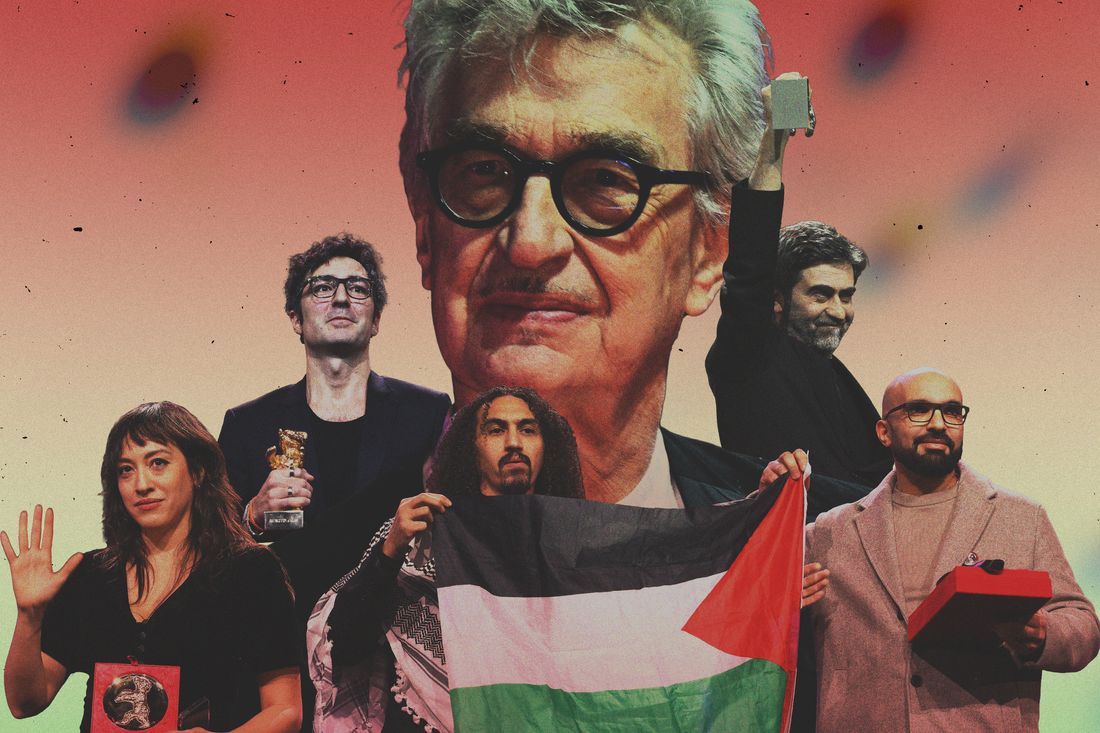

Photo-Illustration: Vulture; Photos: Getty
Can film festivals also be political spaces? That was the absurd question that ran through this year’s Berlin Film Festival. It all began with jury president Wim Wenders saying during the fest’s opening press conference that filmmakers “are the counterweight to politics. We are the opposite of politics,” and it raged over the course of the 11-day event with pretty much everyone getting their digs in. Now, the German government is reportedly reconsidering its relationship with the festival with the country’s minister of state for culture calling “an extraordinary meeting” of the organization that manages the event. One possible, perhaps likely, outcome: The dismissal of festival head Tricia Tuttle from her position.
The question of whether politics belong at film festivals is absurd for a number of reasons, not the least of which is the fact that, however much various officials might attempt to pretend otherwise, Berlin has traditionally been the most politically charged of all the major international festivals. This latter truth was borne out by this year’s closing ceremony, which saw the Golden Bear going to Turkish German director İlker Çatak’s Yellow Letters, a drama about a married creative couple whose world collapses when they’re targeted by the Turkish state for their beliefs, and the Grand Jury Prize (effectively the fest’s second biggest prize) going to another Turkish director, Emin Alper, whose allegorical drama Salvation is about the growing, violent distrust between two Kurdish clans.
That same closing ceremony saw Syrian Palestinian director Abdallah Al-Khatib, whose Chronicles from the Siege won the Perspectives award for emerging filmmakers, holding up a Palestinian flag during his acceptance speech and declaring, “We will remember everyone who stood with us, and we will remember everyone who stood against us, against our right to live with dignity, or who choose silence or choose to be silent.” Al-Khatib then addressed the German government: “You are partners in the genocide in Gaza by Israel,” he said, after noting that he had been warned to be careful with his words given that he is a refugee in Germany. “I believe you are intelligent enough to recognize this truth, but you choose to not care.”
Before that, Lebanese director Marie-Rose Osta, accepting the Best Short Film award for Someday a Child, had addressed Israel’s bombings of her country and Palestine. “No child should need superpowers to survive a genocide empowered by veto powers and the collapse of international law,” she said. “If this Golden Bear means anything, let it mean that Lebanese and Palestinian children are not negotiable.”
What felt like the most politically charged closing ceremony in recent memory may well have been a direct rebuke to Wenders’s initial statement, a response to a question about Palestine. Wenders had been clumsily trying to steer the discussion away from the topic after another jury member’s awkward response, and the question itself was a lot more specific, having to do with the festival’s relationship with the German government and its “selective treatment of human rights” given its outspoken solidarity with Ukraine and the people of Iran and its relative silence regarding genocide in Gaza. That’s a very good question — one that I’m not sure a film-festival jury is particularly well equipped to answer.
Still, this was a predictable scandal, the kind of thing one would have assumed a jury president should prepare for. Indeed, something exactly like this happened at last year’s Venice Film Festival, when that event’s jury president Alexander Payne said “I’m here to judge and talk about cinema” when asked about his views on Gaza. These controversies are getting so commonplace at this point that they should just be on the official schedule: “Noon: Greetings From the Festival Director. 1 p.m.: Jury President Puts Foot in Mouth. 2 p.m.: Light Snacks.”
In Berlin’s case, Wenders’s words set off a snowballing series of calamities, which included Indian novelist Arundhati Roy announcing that she would no longer travel to the festival to be present at a revival screening of a 1989 short she wrote, In Which Annie Give It Those Ones, and an open letter signed by various luminaries and Berlin alumni regarding what they saw as the festival’s suppression of free speech regarding Gaza. A few days later, some of those same luminaries signed yet another open letter, this time defending Tuttle against reports that the government intends to sack her.
Tuttle issued a lengthy statement about the contretemps on February 14, in which she observed, “Some films express a politics with a small ‘p’: they examine power in daily life, who and what is seen or unseen, included or excluded. Others engage with Politics with a capital ‘P’: governments, state policy, institutions of power and justice. This is a choice. Speaking to power happens in visible ways, and sometimes in quieter personal ones.” Then she made another statement on February 18, responding specifically to the (first) open letter and to what she felt were inaccurate and anonymous representations about the festival. What made the whole affair so sad was that everybody seemed to be responding to something different, though it all got lumped into the same rolling controversy. Tuttle herself is now under fire from all sides for contradictory reasons. Even as many criticized her and the festival for not taking a stand on Gaza, the reason for her potential dismissal is the opposite: Because German politicians were incensed at the pro-Palestinian sentiments aired at the closing ceremony. I suppose we can call this ironic, but it’s mostly just sad, not to mention disturbing.
The truth is that film festivals are institutional entities, often relying on a queasy partnership with local and federal governments. (Anyone who has had to sit through a roll call of dignitaries during an opening ceremony can tell you that.) And Germany specifically has rather strict speech laws that strongly limit criticism of Israel, part of Germany’s attempts to atone for its central role in the Holocaust. This, as Tuttle herself made clear, complicates the festival’s position and how directly officials can express themselves. That’s likely one of the reasons why German environment minister Carsten Schneider walked out of Al-Khatib’s acceptance speech. It’s also probably one of the reasons why the festival’s 2024 closing ceremony saw the tragicomic spectacle of German cultural minister Claudia Roth applauding the acceptance speeches of Yuval Abraham and Basel Adra, the Israeli and Palestinian directors of No Other Land, and then issuing a ridiculous statement afterward clarifying that she really meant to just applaud Abraham’s speech and not Adra’s.
But look at these films and these winners. A festival that sought to avoid politics would not have programmed titles like No Other Land or Chronicles from the Siege in the first place. Nor would it have placed Jason Osder and William Lafi Youmans’s documentary, Who Killed Alex Odeh?, about the murder of a Palestinian American activist in 1985, in its main competition this year. This is the central dilemma of festivals today: They have to negotiate government partnerships and play footsie with authority while still providing spaces where politically committed work can find a global audience. (Let’s not forget that it was Payne’s Venice jury that gave its Grand Jury Prize to The Voice of Hind Rajab.) Wenders can sit behind a dais and talk about avoiding politics, but he knows that’s not true: “Every film is political. Most political of all are those that pretend not to be: ‘entertainment’ movies,” he himself once said, as many pointed out in the wake of his initial Berlin press conference.
Wenders actually expanded upon his comments during the festival’s closing ceremony. “The language of cinema is empathetic. The language of social media is effective,” he said. “Cinema is more resistant to oblivion, and certainly longer-living than the short-lived attention span that the internet offers, while our urgency — no, your urgency — reaches places our films cannot … This should not be a competition. It’s a partnership.” I found his words quite moving, but I’m sure that, with the battle lines already drawn, many thought they were unsatisfying.
It’s hard to write about all this without resorting to the same series of out-of-context soundbites that got us here in the first place. And one thing that probably allowed the controversy to keep going was that the Berlin lineup, despite all the excellent work on display, lacked the kind of high-profile, star-driven films that seize the spotlight and change the subject. (At the far glitzier Cannes, very few controversies last more than 48 hours because the latest megastar or discourse-baiting provocateur invariably arrives to distract the armies of journalists and photographers from whatever they previously happened to be arguing about.) But that too is a side effect of the fact that Berlin has always tended to embrace more formally and politically daring work. It’s not an Oscar bellwether, nor is it a place for big festival-season launches. It’s a place for movies like Chronicles from the Siege and No Other Land and Rafael Manuel’s Filipiñana, an austerely stylized drama set on a Manila golf course that becomes a slow-burning case study in capitalism and exploitation. Filipiñana was one of the best pictures I saw at Sundance, but it felt out of place there. In Berlin, it felt like it was home.
A look at the films, both by Turkish directors, that took the two top prizes at Berlin perhaps provides a clue to how the political and the personal are just two sides of the same coin. Yellow Letters follows a married couple, Derya (Özgü Namal) and Aziz (Tansu Biçer), who have themselves reached a level of institutional importance in the theater world: They perform to sold-out crowds in Ankara, and dignitaries come to their pseudo-experimental productions. One day, they discover they’ve been targeted by the state after an anonymous complaint about their political activities. Aziz and several other academics are suspended from their university jobs, and Derya’s most recent production is shut down. Left without any income, they’re forced to move in with Aziz’s mom (İpek Bilgin) in Istanbul, where they also have to find a new school for their headstrong teenage daughter, Ezgi (Leyla Smyrna Cabas).
These are articulate, intellectual characters who tend to speak openly about their emotions and even drift into philosophical ruminations. Over the course of the film, that seeming candidness becomes another form of deflection, as if by so openly addressing their predicament, they’re refusing to truly face the consequences. Yellow Letters starts out as a political thriller, then it morphs into a domestic drama as the challenges of survival, parenthood, and social shame eventually begin to corrode Derya and Aziz’s marriage. Like the best political movies (one could point to such recent examples as The Secret Agent and It Was Just an Accident), Yellow Letters shows how politics poisons intimacy, family relations, and the ordinary business of being alive as the pressures of authoritarianism work their way subtly into our everyday interactions. The film gathers small details — a slight here, an offhand accusation there, a minor humiliation there — that collectively become overwhelming.
Çatak (whose previous feature, The Teachers’ Lounge, was nominated for a Best International Film Oscar) doesn’t let anyone off the hook, nor does he go for cheap shots. In a more simplistic story, Derya and Aziz’s efforts to find a good private school for their daughter would come off as a hopeless bourgeois indulgence. When Aziz starts driving a cab to make ends meet, he does hesitate at first — we can sense a slight twinge of embarrassment — but soon approaches the job with calm resourcefulness. His privilege is not unquestioned, though: One night, his cab winds up outside a small neighborhood theater run by an old Kurdish colleague who presents far more confrontational dramas than Aziz ever did. Their ensuing exchange reveals to us that Aziz had already begun to compromise his ideals when he started working with bigger, more mainstream productions. Principles are not binary, nor is integrity a fixed point. Politics, art, and ideology all exist on a continuum, as the film’s final scenes make clear.
One of Yellow Letters’s most interesting conceits is that German cities play Turkish ones throughout. “Berlin as Ankara” a massive onscreen title announces, and later, “Hamburg as Istanbul.” It’s a charming, complex idea that viewers will interpret differently. To some, it’s an expression of exile, a nod to the movie’s potentially dangerous political status. But the actors (who are all working performers in Turkey) were quick to push back against this at their press conference. “This is not a film that cannot be shot in Turkey. It is a work that was chosen to be filmed here,” Namal said. “It offers certain production conveniences, but that does not mean it is something that cannot be done.” (For the record, Yellow Letters already has a Turkish distributor and release date.)
The notion of a Turkish political drama playing out against German locations speaks to something else, I suspect: It suggests that all this could really happen anywhere. And, of course, that it has: The German past provides a warning against acquiescence to authoritarianism. At one point, Aziz enters a courtroom in “Ankara,” and we see him framed against a giant wall on which the year 1933 is carved. That’s not a particularly significant year in Turkish history. It is, of course, a very significant year in German history: when Hitler and the Nazis were elected into office. Every frame, every angle in a film represents a choice, and how Çatak has chosen to shoot these scenes opens up fascinating avenues of conversation.
Emin Alper, on the other hand, takes an almost diametrically opposite approach with Salvation. If Çatak uses the accumulation of mundane details to portray the pressures on ordinary people, Alper uses the heightened language of myth and allegory to tell a story that nevertheless feels immediately recognizable as belonging to the present. Salvation takes place in a mountainous region of Turkey where two Kurdish clans have grown up in constant distrust of each other. Occupying the highland are the Hazerans, who pride themselves on their toughness and their willingness to fight alongside government forces against terrorist guerillas. (We never actually see the guerillas, giving the proceedings a slyly existentialist kick, like something out of Albert Camus or Dino Buzzati.) On the flat arid plains below lives the farming community of the Bezaris, who are generally seen by the Hazerans as a group of privileged, cowardly usurers. As tensions rise between the two groups, an ambitious Hazeran sheikh, Ferit (Feyyaz Duman), tries to keep the peace, only to find his power usurped by his resentful older brother, Mesut (Caner Cindoruk), who has become convinced that his pregnant wife (Özlem Taş), once a servant to the Bezaris, has been unfaithful to him. Yet again, the personal becomes political, and vice versa.
Though an occasional cellphone or refrigerator does make an appearance, Salvation takes place against an epic, timeless canvas, one filled with torchlit gatherings, solitary figures lurking in caves, and ghostly hallucinations. Alper also makes excellent use of the mountainous landscape and the ancient ruins among which the Hazerans live. The film’s atmosphere is elemental and tense, as if primal, long-suppressed emotions were boiling over. Convinced that their ancestors are communicating with them via dream visions, characters wander dark alleyways at night, pursuing spectral figures. Are there supernatural powers at work in this tale? Alper leans into the mysticism without ever coming down on one side or another, and as the narrative hurtles toward its tragic conclusion, Salvation starts to feel almost like a horror movie. That it’s all taking place in the context of the Turkish military’s actions against unseen terrorists suggests that these hallucinations are occurring at all levels of society, that the paranoia we’re witnessing is a form of social contagion.
Despite the films’ clear outward differences, Alper’s heightened style is somewhat analogous to Çatak’s expansion of his scope by substituting Germany for Turkey. The stark landscapes, the base emotions, the fablelike quality of the storytelling all serve to broaden Salvation beyond this remote corner of Turkey. Alper himself, a historian by training, seemed to reflect that universality in his own very moving acceptance speech, in which he called out to the people of Palestine, the people of Iran, the Kurds of Rojava and the Middle East, as well as numerous Turkish political prisoners, including the popular mayor of Istanbul, Ekrem İmamoğlu. “The most terrible kind of loneliness is the loneliness you experience while suffering,” Alper said. “But when you see that no one cares about you and no one thinks of you, you become the loneliest person in the world. So what we can do here is to break the silence and remind them that they are truly not alone.” Thus, a festival that began with a declaration that cinema and politics were two different things concluded by demonstrating that, in fact, they are inextricably intertwined. And the ongoing fallout is merely further proof of that.
See All